
Proton Pump Inhibitors
Introduction to Proton Pump Inhibitors (PPIs)
Acid-related stomach problems like acid reflux, gastritis, and peptic ulcers are very common today. These conditions usually occur when the stomach produces too much acid, which can irritate or damage the lining of the stomach and esophagus (food pipe).
To manage these conditions, doctors often prescribe a group of medicines called Proton Pump Inhibitors (PPIs). These drugs work by reducing the amount of acid produced in the stomach, helping the digestive system heal and preventing further irritation.
PPIs act on the proton pump (H⁺/K⁺-ATPase enzyme) found in the stomach’s parietal cells. This enzyme is responsible for the final step of gastric acid secretion. By blocking this pump, PPIs significantly reduce acid production and provide relief from symptoms like heartburn, acid reflux, and stomach pain.
Some commonly used PPI include omeprazole, pantoprazole, esomeprazole, rabeprazole, and lansoprazole. Because of their strong acid-suppressing effect, PPIs are widely used in the treatment of GERD, peptic ulcers, H. pylori infection, and NSAID-induced gastric ulcers.
In this article, we will understand how proton pump inhibitors work, their classification, uses, side effects, and important clinical considerations.
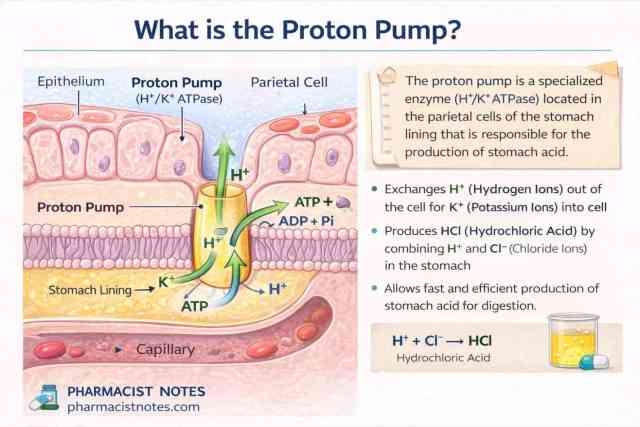
What is the Proton Pump?
The proton pump is a special enzyme found in the parietal cells of the stomach lining that is responsible for producing stomach acid. Its scientific name is H⁺/K⁺-ATPase.
This enzyme works like a tiny molecular pump that actively transports hydrogen ions (H⁺) from the parietal cells into the stomach. At the same time, it brings potassium ions (K⁺) back into the cell. This exchange process requires energy, which comes from ATP, the energy molecule of the cell.
When hydrogen ions (H⁺) released by this pump combine with chloride ions (Cl⁻) in the stomach, they form hydrochloric acid (HCl). This acid plays an important role in digesting food, activating digestive enzymes like pepsin, and killing harmful bacteria that may enter with food.
The proton pump is considered the final step in gastric acid secretion. This means that regardless of which signals stimulate acid production—such as histamine, gastrin, or acetylcholine—they ultimately activate the proton pump to release hydrogen ions into the stomach.
In above paragraph you learned this signal come from histamines as well and that’s how ranitidine works.
Because it controls the final stage of acid secretion, the proton pump becomes an important target for medications like Proton Pump Inhibitors (PPIs), which work by blocking this enzyme and reducing stomach acid production.
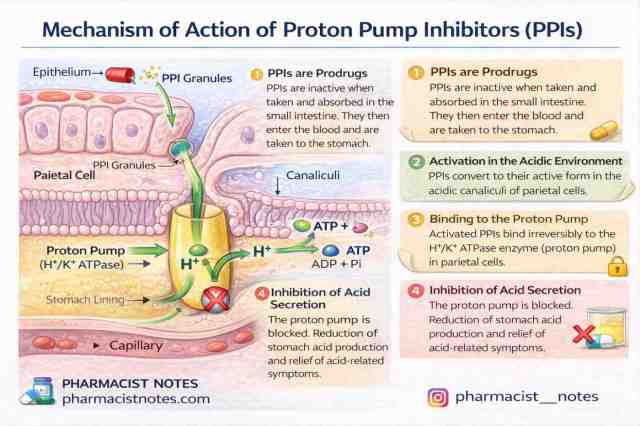
Mechanism of Action of Proton Pump Inhibitors (PPIs)
To understand how Proton Pump Inhibitors (PPIs) work, it is important to remember that stomach acid is produced by parietal cells located in the lining of the stomach. These cells contain an enzyme called the proton pump (H⁺/K⁺-ATPase), which is responsible for the final step of gastric acid secretion.
PPIs reduce stomach acid by specifically blocking this proton pump.
1. PPIs are Prodrugs
Most PPI such as omeprazole, pantoprazole, rabeprazole, and esomeprazole are prodrugs, which means they are inactive when they enter the body. After oral administration, the drug passes through the stomach and is absorbed in the small intestine.
From there, it enters the bloodstream and is transported to the stomach’s parietal cells.
2. Activation in the Acidic Environment
Inside the parietal cells there are small secretory channels called canaliculi, which have a very acidic environment. When PPIs reach this acidic environment, they undergo a chemical change and are converted into their active form.
This activated form of the drug is able to interact with the proton pump.
3. Binding to the Proton Pump
The activated PPI binds to the H⁺/K⁺-ATPase enzyme located on the surface of parietal cells. This enzyme normally exchanges hydrogen ions (H⁺) from the cell with potassium ions (K⁺) from the stomach lumen, using energy from ATP.
By doing this, the enzyme releases hydrogen ions into the stomach, which then combine with chloride ions to form hydrochloric acid (HCl).
PPIs bind irreversibly to this enzyme, meaning they permanently block its activity.
4. Inhibition of Acid Secretion
Once the proton pump is blocked, the parietal cell can no longer release hydrogen ions into the stomach. As a result, the formation of hydrochloric acid decreases significantly.
Because the inhibition is irreversible, acid secretion remains suppressed until the body produces new proton pumps, which may take about 24 to 48 hours.
5. Reduction of Gastric Acidity
By blocking the final step of acid production, PPIs are able to strongly suppress gastric acid secretion, regardless of the stimulus that originally triggered it. This includes acid secretion stimulated by histamine, gastrin, or acetylcholine.
The reduction in stomach acid helps relieve symptoms such as heartburn and acid reflux, and also allows ulcers and inflamed stomach lining to heal.
Classification of Proton Pump Inhibitors (PPIs)
Proton Pump Inhibitors are mainly classified based on the type of drug molecule used to inhibit the proton pump. Although all PPIs work through the same mechanism—blocking the H⁺/K⁺-ATPase enzyme in parietal cells—they differ slightly in their chemical structure, metabolism, and duration of action.
In clinical practice, PPIs are usually classified into the following drugs:
1. Omeprazole
Omeprazole is one of the first proton pump inhibitors introduced and is widely used to treat conditions like GERD, peptic ulcers, and acid reflux. It effectively reduces stomach acid and promotes healing of the stomach lining.
2. Esomeprazole
Esomeprazole is the S-isomer of omeprazole. It provides more consistent acid suppression in some patients and is commonly prescribed for gastroesophageal reflux disease (GERD) and erosive esophagitis.
3. Pantoprazole
Pantoprazole is another commonly used PPI that is often preferred in hospitalized patients because it is available in both oral and intravenous forms. It is widely used for acid reflux, gastric ulcers, and stress ulcer prevention.
4. Rabeprazole
Rabeprazole acts relatively faster compared to some other PPIs and is commonly used in the treatment of peptic ulcer disease and GERD.
5. Lansoprazole
Lansoprazole is frequently used for treating acid reflux, stomach ulcers, and H. pylori infections when combined with antibiotics.
6. Dexlansoprazole
Dexlansoprazole is a newer proton pump inhibitor that has a dual-release formulation, which allows it to control acid secretion for a longer duration and provides better symptom control in GERD.
Pharmacological Effects of Proton Pump Inhibitors (PPIs)
These Inhibitors significantly reduce the production of gastric acid in the stomach. Because of this strong acid suppression, they produce several important pharmacological effects.
1. Marked Reduction in Gastric Acid Secretion
PPIs inhibit the H⁺/K⁺ ATPase proton pump in the gastric parietal cells.
This pump is the final step responsible for acid secretion. When it is blocked, gastric acid production decreases drastically.
2. Increased Gastric pH
Since acid secretion is suppressed, the pH of the stomach increases (becomes less acidic).
This helps protect the gastric mucosa and promotes healing of ulcers.
3. Healing of Peptic Ulcers
By reducing acid exposure, PPIs allow gastric and duodenal ulcers to heal faster.
4. Reduction of Gastroesophageal Reflux Symptoms
Lower acid levels decrease irritation of the esophagus, which helps relieve symptoms like:
- Heartburn
- Acid regurgitation
- Chest discomfort
5. Reduced Gastric Volume and Acidity
PPIs decrease both the volume and acidity of gastric secretions, which is useful before surgical procedures.
6. Promotion of Mucosal Healing
By maintaining a less acidic environment, PPIs support repair and regeneration of the gastric and esophageal mucosa.
Uses of Proton Pump Inhibitors
PPIs are widely used in conditions where excess gastric acid causes damage or symptoms.
1. Peptic Ulcer Disease
PPIs are commonly used to treat:
- Gastric ulcers
- Duodenal ulcers
They reduce acid and allow ulcers to heal faster.
2. Gastroesophageal Reflux Disease (GERD)
PPIs are considered first-line drugs for GERD.
They relieve symptoms like heartburn and prevent esophageal damage.
3. Zollinger–Ellison Syndrome
This condition involves excessive gastrin secretion, leading to massive acid production.
PPIs effectively control this excessive acid secretion.
4. Helicobacter pylori Eradication Therapy
PPIs are used along with antibiotics to treat H. pylori infection.
Reducing acid improves antibiotic effectiveness.
5. Prevention of NSAID-Induced Ulcers
Patients who take long-term NSAIDs (like diclofenac, ibuprofen) are at risk of gastric ulcers.
PPIs are used to protect the stomach lining.
6. Stress Ulcer Prophylaxis
In critically ill hospitalized patients, PPIs help prevent stress-related gastric ulcers.
Adverse Effects of Proton Pump Inhibitors
PPIs are generally safe, but prolonged use may cause some side effects.
Common Side Effects
- Headache
- Nausea
- Diarrhea
- Abdominal pain
- Flatulence
Long-Term Adverse Effects
Long-term use of PPIs may lead to:
1. Vitamin B12 Deficiency
Reduced acid can impair absorption of vitamin B12.
2. Hypomagnesemia
Chronic use may lower magnesium levels.
3. Increased Risk of Bone Fractures
Reduced calcium absorption may increase fracture risk.
4. Increased Risk of Infections
Reduced gastric acidity can increase susceptibility to infections like:
- Clostridium difficile infection
- Pneumonia
5. Rebound Acid Hypersecretion
Stopping PPIs suddenly may lead to increased acid production.
Drug Interactions of Proton Pump Inhibitors
PPIs can interact with several drugs because they affect drug metabolism and gastric pH.
1. Interaction with Clopidogrel
Some PPIs (especially omeprazole) inhibit the CYP2C19 enzyme, which may reduce the activation of clopidogrel and decrease its antiplatelet effect.
2. Reduced Absorption of Certain Drugs
Because PPIs increase gastric pH, they may reduce absorption of drugs that require acidic pH, such as:
- Ketoconazole
- Itraconazole
- Iron salts
3. Interaction with Warfarin
PPIs may increase the effect of warfarin, increasing bleeding risk.
4. Interaction with Diazepam and Phenytoin
Omeprazole can inhibit liver enzymes and may increase the levels of:
- Diazepam
- Phenytoin

5 thoughts on “What are Proton Pump Inhibitors? Their pharmacology, classifications, uses and drug interactions”