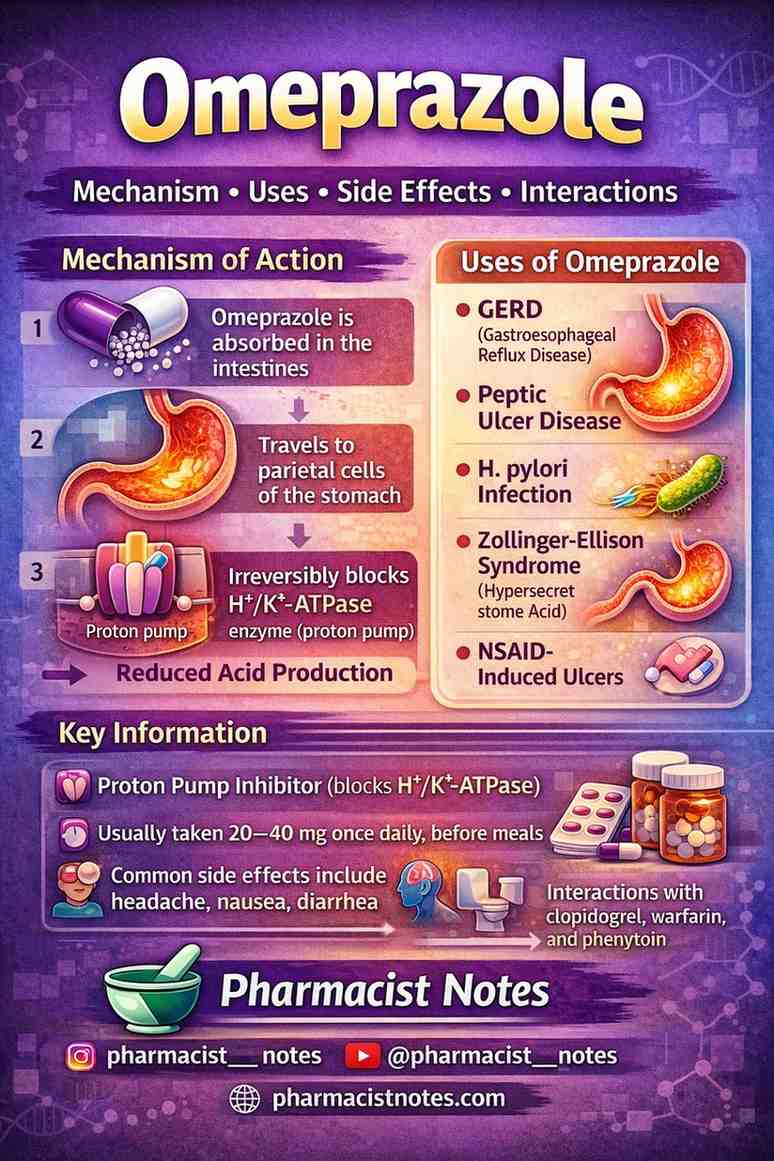
Omeprazole mechanism of action, Uses, Dose, Side Effects and Drug Interactions
Omeprazole is one of the most commonly used medicines for reducing stomach acid. Doctors frequently prescribe it for conditions like acid reflux, stomach ulcers, and GERD.
This medicine belongs to a group of drugs known as proton pump inhibitors (PPIs). These drugs reduce the amount of acid produced in the stomach and help the digestive system heal.
If you want to understand the complete class of PPIs, you can read our detailed guide here: What are Proton Pump Inhibitors? Their pharmacology, classifications, uses and drug interactions
In this article, we will focus specifically on Omeprazole, how it works, when it is used, and the important precautions to know.
What is Omeprazole?
Omeprazole is a medication that reduces the production of stomach acid. It is mainly used to treat conditions where excess acid causes irritation or damage in the digestive system.
You will often see it prescribed for problems like:
- Heartburn
- Acid reflux
- Peptic ulcers
- GERD (Gastroesophageal Reflux Disease)
It is available in capsules, tablets, and injectable forms, and in many countries it can also be purchased over the counter for short-term heartburn relief.
Mechanism of Action of Omeprazole (How it Works)

To understand how omeprazole works, we need to briefly look at how stomach acid is produced.
Inside the stomach lining, there are special cells called parietal cells. These cells release acid through an enzyme known as the proton pump (H⁺/K⁺-ATPase).
This proton pump is actually the final step in acid production.
Omeprazole works by blocking this proton pump.
Step-by-step explanation
- After you take omeprazole, it is absorbed from the small intestine into the bloodstream.
- The drug then travels to the parietal cells in the stomach.
- In the acidic environment of these cells, the drug becomes activated.
- The activated form binds to the proton pump enzyme.
- This blocks the pump and stops acid from being released into the stomach.
An important point is that this inhibition is irreversible.
This means the pump cannot work again until the body produces new proton pumps, which is why the drug continues to work for many hours.
Pharmacokinetics (What the Body Does to the Drug)
Absorption
Omeprazole is absorbed in the small intestine. Because stomach acid can destroy the drug, it is usually given in enteric-coated capsules or tablets.
Bioavailability
After repeated doses, the bioavailability is about 60%.
Distribution
Once absorbed, most of the drug binds to plasma proteins and travels through the bloodstream.
Metabolism
The drug is mainly metabolized in the liver, especially by the enzymes CYP2C19 and CYP3A4.
Excretion
The metabolites are mostly eliminated through the urine (~77%), while a smaller portion leaves the body through feces.
Uses of Omeprazole
Omeprazole is widely used for treating different acid-related disorders.
GERD (Gastroesophageal Reflux Disease)
GERD occurs when stomach acid repeatedly flows back into the esophagus.
Omeprazole helps by reducing acid production and allowing the esophagus to heal.
Peptic Ulcer Disease
It helps in the treatment of both gastric ulcers and duodenal ulcers by lowering stomach acidity and promoting healing.
Helicobacter pylori Infection
Omeprazole is often used together with antibiotics such as amoxicillin and clarithromycin to eliminate H. pylori, a bacterium that causes ulcers.
Zollinger–Ellison Syndrome
This rare condition causes extremely high acid production. Omeprazole helps control the excessive acid secretion.
Prevention of NSAID-Induced Ulcers
Patients who take painkillers like ibuprofen or diclofenac for long periods may develop ulcers. Omeprazole is sometimes prescribed to protect the stomach lining.
to Know why does long use of painkiller cause ulcer refer Can I Take Pain Killers Daily?
Omeprazole doses
The dose depends on the condition being treated, but commonly used doses include:
- GERD: 20 mg once daily
- Duodenal ulcer: 20 mg daily for about 4 weeks
- Gastric ulcer: 20–40 mg daily for 4–8 weeks
- Zollinger-Ellison syndrome: higher doses may be required
Doctors usually recommend taking omeprazole before meals, preferably in the morning.
Side Effects of Omeprazole
Most people tolerate omeprazole well, but some side effects can occur.
Common Side Effects
- Headache
- Nausea
- Diarrhea
- Abdominal pain
- Gas or bloating
These are usually mild and disappear after stopping the medication.
Possible Problems with Long-Term Use
Long-term use of PPIs like omeprazole may sometimes lead to:
- Vitamin B12 deficiency
- Low magnesium levels
- Increased risk of bone fractures
- Higher risk of certain intestinal infections
Because of this, long-term therapy should be used only under medical supervision.
Drug Interactions with Omeprazole
Omeprazole can interact with some medications.
1. Clopidogrel
Omeprazole may reduce the activation of clopidogrel, which could decrease its blood-thinning effect.
Clopidogrel is actually a prodrug, which means the tablet you take is not active by itself. After entering the body, it must first be converted into its active form in the liver. This conversion mainly happens through a liver enzyme called CYP2C19.
Omeprazole also affects this same enzyme.
When someone takes omeprazole and clopidogrel together, omeprazole can inhibit (block) the CYP2C19 enzyme. Because of this, the liver cannot convert enough clopidogrel into its active form.
As a result, less active clopidogrel is produced, which means the drug cannot thin the blood as effectively as it should.
In simple words:
- Clopidogrel needs CYP2C19 to become active.
- Omeprazole blocks CYP2C19.
- Because of this, clopidogrel activation decreases, and its blood-thinning effect may be reduced.
This interaction is important because clopidogrel is often prescribed to prevent heart attacks and strokes, so reducing its effectiveness could increase the risk of blood clot formation.
That is why doctors sometimes prefer using another PPI, such as pantoprazole, which has less effect on CYP2C19 and is considered safer to use with clopidogre
2. Warfarin, Diazepam, Phenytoin
It may increase the levels of these drugs by slowing their metabolism.
This happens because omeprazole affects certain enzymes in the liver that are responsible for breaking down drugs.
When we take medicines like warfarin, diazepam, or phenytoin, the body normally removes them by metabolizing them in the liver. This process mainly involves liver enzymes such as CYP2C19 and CYP3A4.
Omeprazole can inhibit (slow down) these enzymes.
When these enzymes are slowed down, the body cannot break down some drugs as quickly as it normally would. Because of this, the medicines stay in the bloodstream for a longer time, which can lead to higher drug levels in the body.
In simple terms:
- The liver normally breaks down drugs to remove them from the body.
- Omeprazole slows down this breakdown process.
- As a result, some drugs remain in the body longer and their levels increase.
This is why medicines like warfarin, diazepam, and phenytoin may have stronger or prolonged effects when taken together with omeprazole, and doctors may sometimes need to adjust the dose or monitor the patient carefully.
3. Drugs that need acidic pH
Some medicines require stomach acid for proper absorption. Since omeprazole reduces acid, it may decrease the effectiveness of drugs such as ketoconazole.
Here are some common questions people ask about omeprazole.
1. What is omeprazole mainly used for?
Omeprazole is a medicine that reduces the amount of acid produced in the stomach. Doctors commonly prescribe it for conditions like acid reflux (GERD), stomach ulcers, and heartburn. By lowering acid levels, it helps relieve symptoms and allows the stomach lining to heal.
2. How does omeprazole reduce stomach acid?
Omeprazole works by blocking a special enzyme in the stomach called the proton pump (H⁺/K⁺-ATPase). This enzyme is responsible for the final step of acid production. When omeprazole blocks this pump, the stomach produces much less acid.
3. Is omeprazole a proton pump inhibitor (PPI)?
Yes. Omeprazole belongs to a group of medicines called proton pump inhibitors (PPIs). These drugs are widely used to treat acid-related problems because they are very effective at reducing stomach acid.
4. When should I take omeprazole?
Omeprazole is usually taken once a day before a meal, most often 30–60 minutes before breakfast. Taking it before food helps the medicine work better because the proton pumps become active when we start eating.
5. What are the common side effects of omeprazole?
Most people tolerate omeprazole well, but some may experience mild side effects such as:
- Headache
- Nausea
- Diarrhea
- Stomach pain
- Gas or bloating
These side effects are usually temporary and improve once the body adjusts to the medicine.
6. Can omeprazole be taken for a long time?
Omeprazole can be used for long-term treatment if recommended by a doctor. However, long-term use may sometimes be associated with issues like vitamin B12 deficiency, low magnesium levels, or an increased risk of bone fractures, so regular medical supervision is important.
7. Can omeprazole interact with other medicines?
Yes, omeprazole can interact with certain medicines. For example, it may affect drugs like clopidogrel, warfarin, diazepam, and phenytoin because it slows down the liver enzymes that normally break down these medicines.
8. How quickly does omeprazole start working?
Omeprazole begins reducing acid production within a few hours, but its full effect is usually seen after a few days of regular use. That is why it may take a little time for symptoms like heartburn to completely improve.
9. Can I take omeprazole with food?
Omeprazole works best when taken before food, preferably before breakfast. Taking it before meals allows the drug to block the proton pumps when they are most active.
10. Is omeprazole available without a prescription?
In many countries, low-dose omeprazole is available over the counter for short-term relief of heartburn or acid reflux. However, if symptoms continue for a long time, it is important to consult a doctor.


2 thoughts on “Omeprazole: Mechanism of Action, Uses, Dose, Side Effects and Drug Interactions”