Raberazole Table of content
Introduction to Rabeprazole
Rabeprazole is a medicine that belongs to a group of drugs known as proton pump inhibitors (PPIs). These medicines are widely used to reduce the amount of acid produced in the stomach.
Doctors commonly prescribe rabeprazole for conditions such as acid reflux, GERD, stomach ulcers, and other acid-related disorders. By reducing excess stomach acid, rabeprazole helps relieve symptoms like heartburn, chest discomfort, and acid regurgitation, and also helps the damaged lining of the stomach and esophagus heal.
Classification
Rabeprazole belongs to the class of drugs called Proton Pump Inhibitors (PPIs).
Other drugs in this class include:
- Omeprazole
- Esomeprazole
- Lansoprazole
- Pantoprazole
All these drugs work by blocking the proton pump responsible for acid secretion in the stomach.
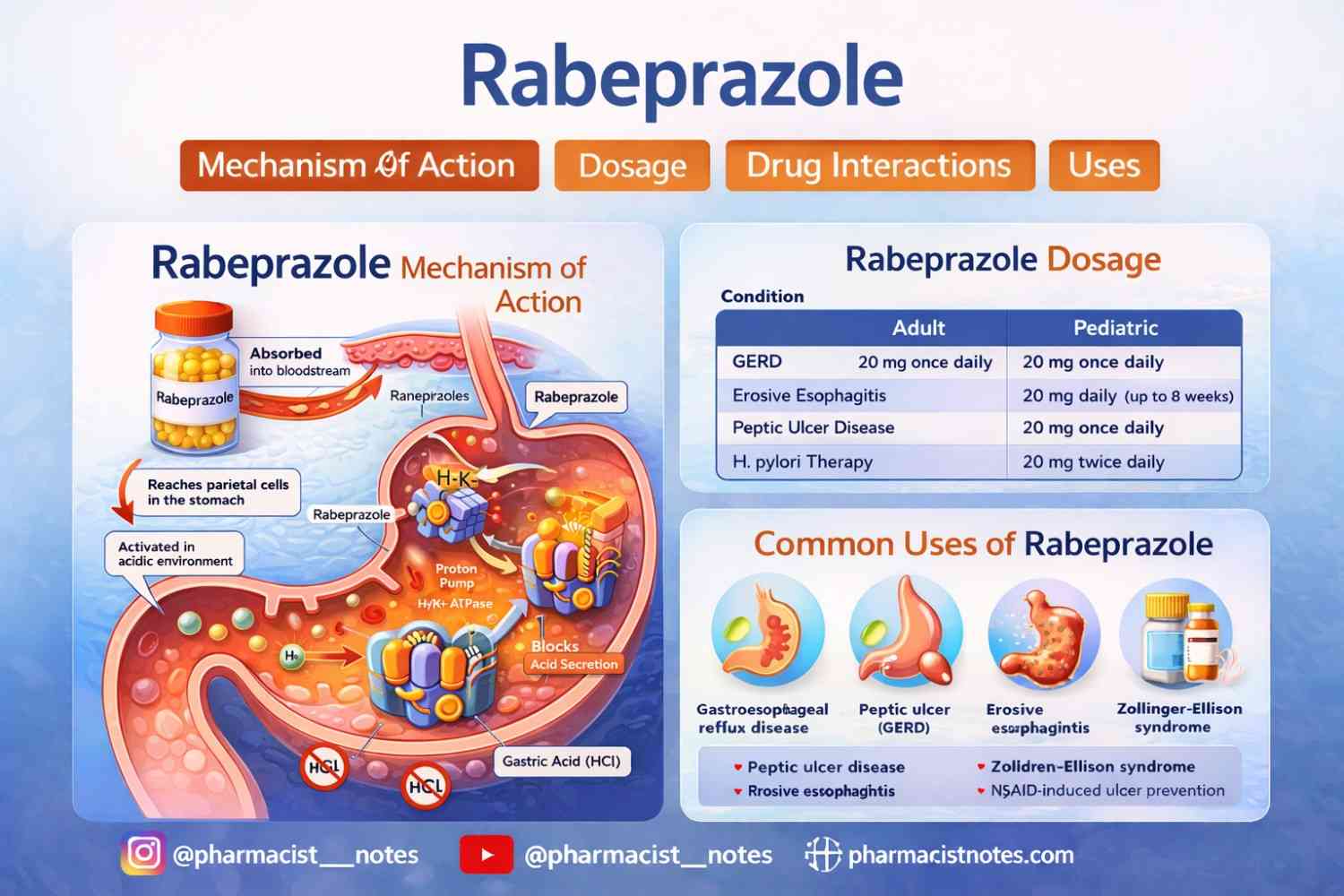
Rabeprazole Mechanism of Action

Rabeprazole works by blocking the proton pump (H⁺/K⁺-ATPase enzyme) located in the parietal cells of the stomach. This enzyme is responsible for the final step in the production of gastric acid.
How it works step by step
- Rabeprazole reaches the parietal cells of the stomach lining.
- In the acidic environment of these cells, the drug becomes activated.
- The active form of rabeprazole binds to the proton pump (H⁺/K⁺-ATPase).
- This binding blocks the final step of acid secretion in the stomach.
- As a result, the production of gastric acid is significantly reduced.
Because this inhibition is irreversible, acid secretion remains suppressed until the body produces new proton pumps.
Pharmacological Effects
Rabeprazole produces several therapeutic effects due to its acid-suppressing action.
Decrease in gastric acid secretion
Rabeprazole significantly lowers the secretion of hydrochloric acid in the stomach.
Increase in stomach pH
When acid production decreases, the gastric pH increases, making the stomach environment less acidic.
Healing of ulcers
Reduced acidity allows gastric and duodenal ulcers to heal faster and prevents further irritation.
Uses
Rabeprazole is commonly used in the treatment of the following conditions:
- Gastroesophageal reflux disease (GERD)
- Peptic ulcer disease
- Erosive esophagitis
- Zollinger–Ellison syndrome
- Prevention of NSAID-induced ulcers
- Helicobacter pylori eradication therapy (in combination with antibiotics)
Dosage of Rabeprazole
The dosage of rabeprazole depends on the medical condition, severity of symptoms, and patient response. It is usually taken once daily before meals.
Adult Dose
Typical adult doses include:
GERD
20 mg once daily for 4–8 weeks
Erosive esophagitis
20 mg once daily for up to 8 weeks
Peptic ulcer disease
20 mg once daily
H. pylori eradication therapy
20 mg twice daily along with antibiotics
Rabeprazole tablets are commonly available in 10 mg and 20 mg strengths.
Pediatric Dose
Rabeprazole may be used in children aged 12 years and older for GERD.
Typical dose:
20 mg once daily
Treatment duration is generally up to 8 weeks depending on the doctor’s recommendation.
Use in Pregnancy
Rabeprazole should only be used in pregnancy when clearly necessary and prescribed by a doctor.
Rabeprazole is classified as Pregnancy Category B.
That is, animal studies have not shown major harm, human data is limited, so doctors carefully weigh the benefits and risks before prescribing it.
Use During Breastfeeding
Rabeprazole may pass into breast milk in small amounts. Because of this, it should be taken only under medical supervision during breastfeeding.
Popular Brand Names of Rabeprazole
Rabeprazole is marketed under different brand names around the world.
India
Common brands include:
- Rablet
- Rabium
- Rabekind
- Rabicip
- Rabez
Combination brands (Rabeprazole + Domperidone):
- Rablet-D
- Rabium-D
- Rabicip-D
United States (US)
In the United States, rabeprazole is marketed as:
AcipHex
United Kingdom (UK)
In the UK, rabeprazole is available as:
- Pariet
- Rabeprazole (generic)
Adverse Effects
Rabeprazole is generally well tolerated, but some side effects may occur.
Common side effects
- Headache
- Diarrhea
- Nausea
- Abdominal discomfort
- Dizziness
Long-term adverse effects
Long-term use of proton pump inhibitors may increase the risk of:
- Vitamin B12 deficiency
- Hypomagnesemia (low magnesium levels)
- Bone fractures
- Gastrointestinal infections
Drug Interactions
Rabeprazole may interact with certain medications because it reduces stomach acidity, which can affect the absorption of some drugs.
Important interactions include:
Clopidogrel
Some PPIs may interfere with CYP2C19 enzymes, which are needed to activate clopidogrel.
Ketoconazole
Ketoconazole requires an acidic environment for absorption, so reduced stomach acid may decrease its effectiveness.
Iron salts
Lower stomach acidity may reduce the absorption of iron supplements.
Atazanavir
Rabeprazole can decrease the absorption of atazanavir, an antiretroviral drug used in HIV treatment.
Methotrexate
High-dose methotrexate may accumulate in the body when used with PPIs, increasing the risk of toxicity.
Patients should always inform their doctor about all medications they are taking before starting rabeprazole.
Key Points / Summary
- Rabeprazole is a proton pump inhibitor used to reduce stomach acid production.
- It works by irreversibly inhibiting the H⁺/K⁺-ATPase proton pump in gastric parietal cells.
- It is widely used to treat GERD, peptic ulcers, and other acid-related disorders.
- The usual adult dose is 20 mg once daily.
- Long-term therapy should be monitored because it may lead to nutrient deficiencies and other complications.


One thought on “Rabeprazole Mechanism of Action, Uses, Dosage, Side Effects & Drug Interactions”