Esomeprazole-Table of Contents
Introduction
Esomeprazole is a medicine that helps reduce excess acid in the stomach.
Sometimes, our stomach produces too much acid, which can cause:
- burning sensation (heartburn)
- acid coming back into the mouth
- chest discomfort
It helps control this extra acid and allows the stomach lining to heal.
Classification
It belongs to a group of medicines called Proton Pump Inhibitors (PPIs)
Other drugs in this group include:
All of them work in a similar way — they reduce acid production in the stomach.
Mechanism of Action

Let’s understand this in a very simple way
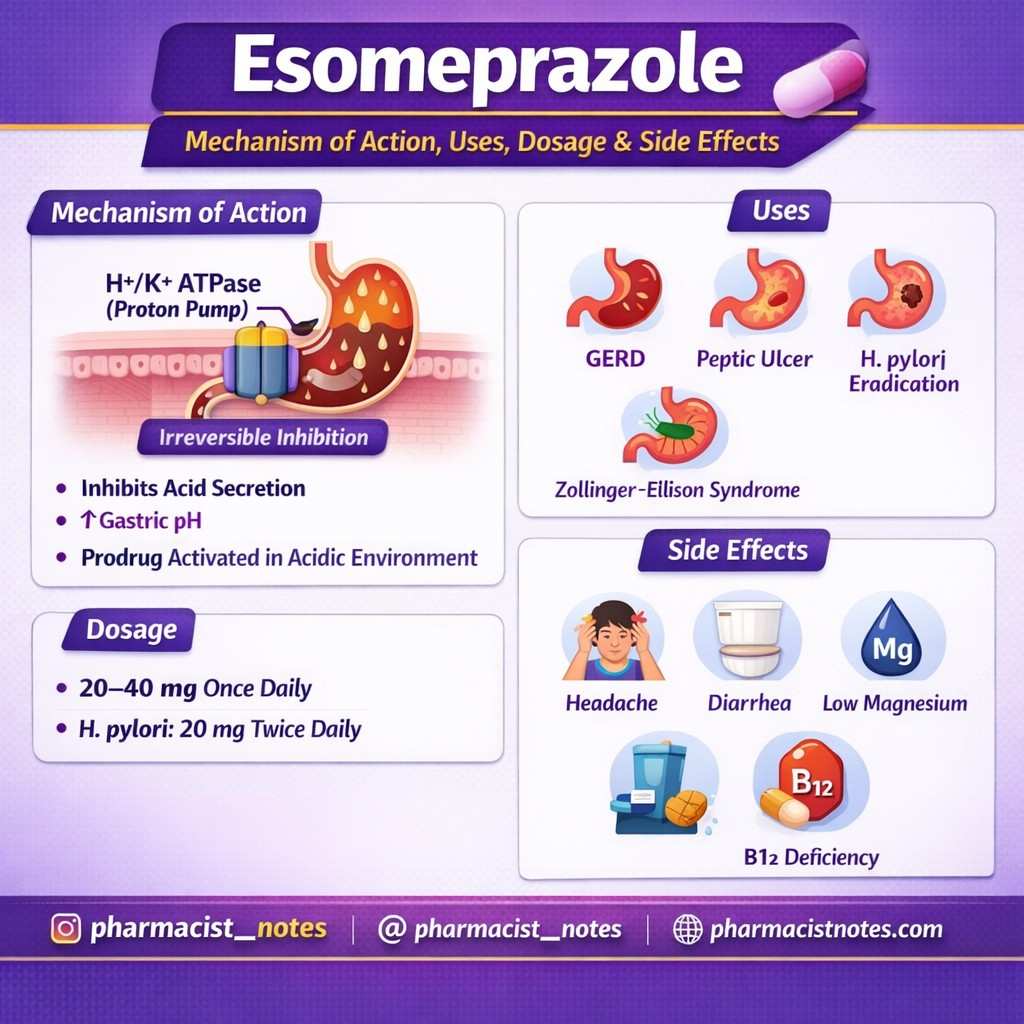
It is a prodrug that becomes active in the acidic environment of gastric parietal cells.
Step-by-step mechanism
- After oral administration, it is absorbed into the bloodstream.
- It selectively accumulates in the parietal cells of the stomach.
- In the acidic canaliculi of these cells, it is converted into its active sulfenamide form.
- The activated drug covalently binds to the H⁺/K⁺-ATPase enzyme (proton pump).
- This leads to irreversible inhibition of the proton pump.
As a result, the final step of gastric acid secretion is blocked, leading to a significant and prolonged reduction in acid production.
Pharmacological Effects
Reduction of gastric acid secretion
It markedly decreases the secretion of hydrochloric acid (HCl).
Increase in gastric pH
With reduced acid production, the gastric pH increases, creating a less acidic environment.
Mucosal healing
The reduction in acidity allows ulcers and inflamed mucosa to heal effectively.
Uses
It is widely used in the management of:
- Gastroesophageal reflux disease (GERD)
- Peptic ulcer disease
- Erosive esophagitis
- Zollinger–Ellison syndrome
- Helicobacter pylori eradication therapy (in combination with antibiotics)
Dosage
The dosage depends on the indication, severity of disease, and patient response. It is usually administered once daily before meals, preferably before breakfast.
Adult Dose
GERD
20–40 mg once daily for 4–8 weeks
Erosive Esophagitis
20–40 mg once daily
Peptic Ulcer Disease
20–40 mg once daily
H. pylori eradication
20 mg twice daily along with antibiotics
it is available in 20 mg and 40 mg formulations.
Pediatric Dose
it may be used in children (usually ≥1 year), with dosing based on body weight and clinical condition.
Use in Pregnancy
it should be used during pregnancy only when clearly indicated.
It was previously classified under Pregnancy Category B (US FDA old classification), indicating no significant risk in animal studies, but limited human data.
Use During Breastfeeding
it may be excreted in breast milk in small amounts. Therefore, it should be used with caution and under medical supervision.
Popular Brand Names
India
- Nexpro
- Esomac
- Sompraz
- Esoz
Combination brands:
Sompraz-D
Nexpro-RD
United States (US)
- Nexium
United Kingdom (UK)
- Nexium
- Esomeprazole (generic)
Adverse Effects
It is generally well tolerated.
Common side effects
- Headache
- Diarrhea
- Nausea
- Abdominal pain
- Flatulence
Long-term adverse effects
With prolonged use, PPIs may cause:
- Vitamin B12 deficiency
- Hypomagnesemia
- Increased risk of bone fractures
- Gastrointestinal infections
Drug Interactions
It may interact with certain drugs due to its effect on gastric pH and hepatic enzymes (CYP2C19).
Clopidogrel
It may inhibit CYP2C19, reducing the activation of clopidogrel and decreasing its antiplatelet effect.
Ketoconazole
Requires an acidic environment thus absorption decreases.
Iron salts
Reduced acidity thus decreased iron absorption.
Atazanavir
Higher gastric pH thus reduced absorption and efficacy.
Methotrexate
May reduce clearance → increased toxicity risk.
Key Points / Summary
- It is a proton pump inhibitor (PPI) used to suppress gastric acid secretion.
- It is a prodrug activated in acidic conditions of parietal cells.
- It irreversibly inhibits the H⁺/K⁺-ATPase proton pump.
- Commonly used for GERD, peptic ulcers, and acid-related disorders.
- Usual adult dose: 20–40 mg once daily.
- Long-term use should be monitored carefully due to potential adverse effects.
FAQs
1. What is Esomeprazole used for?
It is used to treat acid-related conditions such as GERD, peptic ulcers, and acid reflux. It helps reduce excess stomach acid and promotes healing of the stomach lining.
2. How does Esomeprazole work?
It works by irreversibly inhibiting the H⁺/K⁺-ATPase proton pump in gastric parietal cells, which blocks the final step of acid production in the stomach.
3. When should Esomeprazole be taken?
It is usually taken before meals, preferably in the morning, for better acid control.
4. What is the usual dose of Esomeprazole?
The usual adult dose is 20–40 mg once daily, depending on the condition being treated.
5. Is It safe for long-term use?
It is generally safe, but long-term use should be monitored, as it may lead to vitamin B12 deficiency, low magnesium levels, or increased risk of fractures.
6. Can Esomeprazole be used in pregnancy?
It should be used during pregnancy only if prescribed by a doctor, after evaluating the benefits and risks.
7. What are the common side effects of Esomeprazole?
Common side effects include headache, diarrhea, nausea, and abdominal pain.
8. Can Esomeprazole interact with other medicines?
Yes, It can interact with drugs like clopidogrel, ketoconazole, iron supplements, atazanavir, and methotrexate.
9. Is It better than other PPIs?
It is considered more potent in some cases and may provide better acid suppression, but the choice depends on the patient and condition.
10. Why is Esomeprazole taken before food?
It is taken before food because proton pumps are most active after meals, and taking it before food allows the drug to block acid production more effectively.


One thought on “Esomeprazole: Mechanism, Uses, Dosage, Side Effects”