If you are above 30 or 40 and you have been dealing with a stiff neck, a dull pain at the back of the head, or tingling in your fingers, there is a good chance that someone has already told you, “it is just cervical spondylosis.” Maybe you saw the word on an X-ray or MRI report and wondered what it really means.
The word sounds heavy. But in simple language, cervical spondylosis means age-related wear and tear of the bones, discs and joints of your neck. It is extremely common, and in most people it is manageable without surgery.
In my work as a pharmacist, I see the same story almost every week: someone with neck pain gets a prescription for a painkiller, a muscle relaxant and maybe a tablet for dizziness, feels better for a few days, and then the pain returns. The tablets were never the whole answer. So today, let’s understand cervical spondylosis properly: what it is, why it happens, how it is diagnosed, which medicines are used, which exercises help, and which warning signs you must never ignore.
Table of Contents
What is cervical spondylosis?
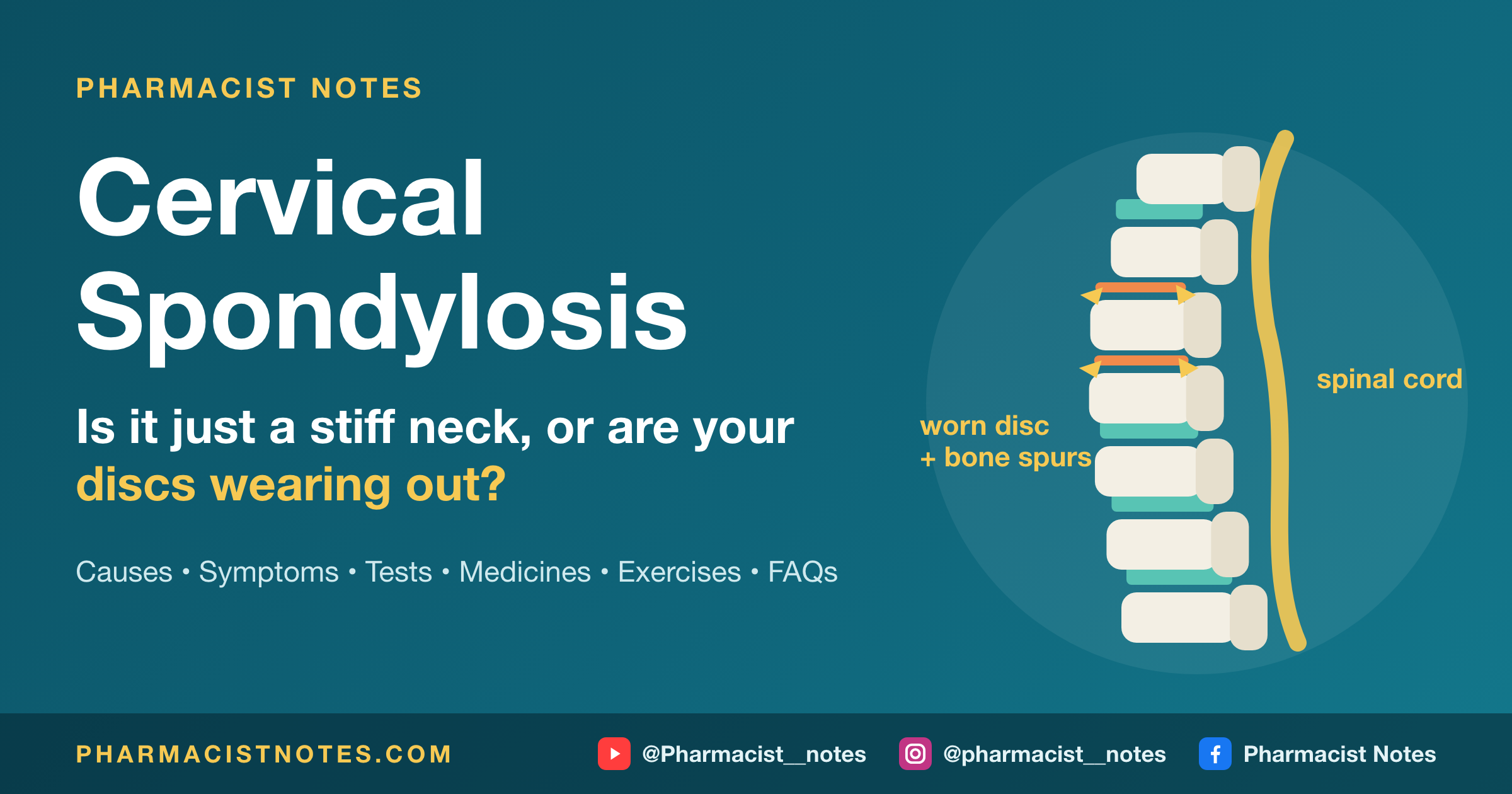
Your neck (the cervical spine) is made of seven small bones called vertebrae, stacked one above the other. Between them sit soft cushions called discs, and at the back there are small joints called facet joints. Inside this stack runs your spinal cord, and from it, nerves branch out to your shoulders, arms and hands.
With age, these structures slowly wear out. This is what happens in cervical spondylosis:
- The discs lose water and become thinner, like a sponge that has dried up.
- The body tries to repair the damage by growing small bony outgrowths called osteophytes (bone spurs).
- The ligaments at the back of the spine can thicken.
- The space for the spinal cord and nerves slowly becomes narrower.

Now here is the most important thing to understand: wear and tear on a scan is not the same as pain. Studies show that degenerative changes of the neck are very common in people above 50, and many of them have no symptoms at all. So a scary-looking report does not automatically mean a serious problem. What matters is your symptoms and what your doctor finds on examination.
Is cervical spondylosis the same as loss of cervical lordosis?
No, but they are related and often seen together. Cervical lordosis is the natural forward curve of the neck. When this curve becomes straight, we call it loss of cervical lordosis, and it is usually linked with muscle spasm and posture. Cervical spondylosis, on the other hand, is the degenerative change of the discs and joints. A straight neck on X-ray can be one of the findings in spondylosis, but it can also happen in younger people only because of long sitting hours.
Why does cervical spondylosis happen?
There is no single cause. It is usually a combination of things that add up over the years:
- Age: this is the biggest factor. Most people show some degree of neck degeneration by their 50s or 60s.
- Repeated strain: jobs that involve long hours of desk work, looking down at a phone, or carrying heavy loads on the head or shoulders.
- Old injuries: a previous whiplash, fall or sports injury to the neck.
- Family history: some families seem to develop spine degeneration earlier.
- Smoking: it reduces blood supply to the discs and may speed up their wear.
- Poor posture and little movement: this does not directly cause spondylosis, but it keeps the neck muscles tight and can make symptoms worse.
I will be honest here: the link between screen time and cervical spondylosis is not as clear in research as social media makes it sound. But poor posture certainly makes an already-tired neck hurt more, and that part is fully in your hands.
Symptoms of cervical spondylosis
Many people with cervical spondylosis have no symptoms at all. When symptoms do appear, they usually fall into three patterns, and it helps to know which one you are dealing with.

1. Neck pain and stiffness (the most common)
- Dull ache or stiffness in the neck, often worse after long sitting or in the morning
- Pain when turning the head, or a grinding feeling
- Pain spreading to the shoulders or between the shoulder blades
- Headache starting at the back of the head
2. Radiculopathy: when a nerve is irritated
Here the bone spur or a bulging disc presses on a nerve root as it leaves the spine. The typical features are:
- Pain that shoots from the neck down into one arm, sometimes past the elbow into the hand
- Tingling, “pins and needles” or numbness in particular fingers
- Weakness of grip, or difficulty lifting the arm
- Pain that increases when you bend the neck backwards or towards the painful side
The good news: radiculopathy usually improves over weeks to months with conservative treatment, and surgery is needed only in a small number of people.
3. Myelopathy: when the spinal cord is squeezed
This is the least common but the most important one, because the spinal cord is involved and the damage can be hard to reverse. Watch out for:
- Clumsy hands: difficulty with buttons, writing, or dropping things
- Unsteady walking, feeling that the legs are heavy or stiff
- Numbness in both hands or both legs
- Changes in bladder or bowel control (a late sign)
If any of these are present, please do not wait. This needs an MRI and a spine specialist’s opinion without delay.
Can cervical spondylosis cause dizziness?
Yes, it can be one of the contributors, and this is a question I get very often at the counter. Stiff neck muscles and joints can disturb the balance signals that reach the brain, which people feel as a vague imbalance or “chakkar” when they move the neck. But dizziness has many other causes, such as inner-ear problems like BPPV, low blood pressure, and even low sodium (hyponatremia). That is exactly why a good doctor does not stop at the neck X-ray.
Medicines like Cinnarizine can calm the dizziness for a while, but they do not treat the neck itself. For the full picture of how a doctor sorts out neck-related dizziness, you can also read my article on loss of cervical lordosis.
Red flags: when to see a doctor urgently

Most neck pain is not dangerous. But please see a doctor quickly, or go to the emergency department, if you notice any of the following:
- Clumsy hands, repeated stumbling or a changed way of walking
- Loss of bladder or bowel control
- Weakness or numbness that is steadily getting worse
- Fever, night sweats or unexplained weight loss along with neck pain
- Severe pain at night that does not ease with rest, or pain after a fall or accident
- Neck pain with a history of cancer or a weak immune system
Also remember: if dizziness comes with slurred speech, double vision, facial droop or weakness on one side of the body, think of stroke first and call for emergency help. Do not blame the neck.
How is cervical spondylosis diagnosed?
Diagnosis starts with the doctor listening to your story and examining you. They will check how well your neck moves, test the strength, sensation and reflexes of your arms and legs, and may do a simple manoeuvre called Spurling’s test to see if neck movement reproduces your arm pain.
Tests are added only when needed:
| Test | What it shows | When it is usually done |
|---|---|---|
| X-ray of the cervical spine | Narrowed disc spaces, bone spurs, loss of the normal curve | Often the first test; helps but correlates poorly with pain |
| MRI | Discs, nerves and spinal cord in detail, including cord compression | Red flags, nerve or cord signs, symptoms lasting beyond 4–6 weeks, or before planning surgery |
| CT scan | Fine bony detail | When MRI is not possible or bone detail is needed |
| Nerve conduction study / EMG | Which nerve is affected and how badly | When the diagnosis is unclear or nerve problems may come from elsewhere |
| Blood tests | Vitamin B12, vitamin D, thyroid, inflammation markers | To rule out other causes of tingling, weakness or pain |
Pharmacist tip: An X-ray or MRI report that says “degenerative changes” is very common after 40. Please do not panic, and do not start treating the report. Treat the person: your symptoms, your examination findings and your daily function.
Cervical spondylosis treatment
The most reassuring fact is that in most people without red flags, cervical spondylosis is treated without surgery. I like to explain it as a ladder: start with the simple steps, and move up only if you need to.

Medicines used for cervical spondylosis
Now let’s talk about the part I know best as a pharmacist. Medicines here are for symptom control. They make it possible for you to move, exercise and sleep, but they do not remove the bone spurs.
| Medicine group | Examples | What to know |
|---|---|---|
| Simple painkiller | Paracetamol | Safest first choice for mild pain; do not exceed the daily limit your doctor advises |
| NSAIDs (anti-inflammatory) | Aceclofenac, naproxen, etoricoxib, diclofenac | Short courses only, preferably after food. Risk to stomach, kidney and heart with regular use; elderly and heart or kidney patients need extra caution |
| Muscle relaxants | Thiocolchicoside, chlorzoxazone, tizanidine | For painful muscle spasm, for a few days only. They can cause drowsiness, so take care while driving |
| Nerve pain medicines | Pregabalin, gabapentin, duloxetine, low-dose amitriptyline | For arm pain and tingling from an irritated nerve; prescription only, started at low doses |
| Short steroid course or injection | Oral steroids, epidural steroid injection | Specialist decision for severe nerve pain that does not settle; not a routine option |
| Vitamins | Vitamin B12, vitamin D | Useful only when a blood test shows a deficiency, not for everyone |
A few practical points from my experience at the dispensing counter:
- Most neck-pain prescriptions come as a ready-made tablet that combines an NSAID with a muscle relaxant (the “-MR” brands). They are convenient, but they are meant for a short course. If you want to understand the two main relaxants and their safety limits, read Thiocolchicoside vs Chlorzoxazone.
- If you take an NSAID for more than a few days, ask your doctor about stomach protection, and remember the right timing of pantoprazole before meals.
- Strong injectable painkillers such as Toradol (ketorolac) are not for casual or repeated use.
- Even a very common painkiller like diclofenac is generally safe in prescribed doses, but not something to take daily on your own.
- Never keep repeating the same prescription for months. If pain keeps coming back, the plan needs to change, not the strip.
Do you need a cervical collar or traction?
A soft cervical collar may give short-term comfort during a severe flare, but wearing it for weeks makes neck muscles weaker and stiffer. Traction is used by some physiotherapists, but evidence is mixed, so it should be done only on your doctor’s or physiotherapist’s advice. Avoid forceful neck cracking or “jerk” manipulation by untrained people, because it can injure the neck.
Exercises for cervical spondylosis
Being a pharmacist, I am not an expert in physiotherapy, so I discussed these basic movements with doctors and checked them against trusted sources. As always, please learn them first from a physiotherapist, and start slowly.
- Keep your laptop or monitor at eye level. If you work on a laptop for long hours, an adjustable laptop stand (for example, the PLIXIO foldable stand with a 360° rotating base) lifts the screen to eye level, so your neck stays straight. Pair it with an external keyboard and mouse.
- If you often work from a sofa or bed, a foldable laptop table (for example, the Etekcity wooden study table) gives your laptop and forearms proper support, so you do not hunch over with the laptop on your lap.
- Hold the phone up to eye level instead of bending your neck down.
- Take a 2-minute movement break every 30 to 45 minutes. Stand up, roll your shoulders, and do a few chin tucks.
- Use one thin pillow that keeps the neck in line with your spine. Avoid sleeping on your stomach.
- Do not carry heavy bags on one shoulder, and avoid carrying loads on the head.
- Walk regularly, stay active and, if you smoke, try to quit.
- Manage stress. Tight shoulders and jaw during stressful days can make neck pain worse.
- There are signs of myelopathy that are moderate, severe or getting worse
- Arm pain or weakness from a pinched nerve continues despite a proper period of non-surgical treatment
- There is progressive nerve weakness
- Pain is severe and truly disabling, and the scan matches the symptoms
- Cervical spondylosis is age-related wear and tear of the neck bones and discs, and it is very common.
- Many people have changes on a scan but no symptoms. Treat the person, not the report.
- It can cause neck pain, arm pain with tingling (radiculopathy) or, rarely, spinal cord compression (myelopathy).
- Clumsy hands, trouble walking or bladder and bowel changes are red flags that need urgent care.
- Most people improve with exercises, posture changes and short courses of medicines.
- Medicines control symptoms. Exercise and lifestyle change are the long-term treatment.
- Surgery is for a small group with cord compression or persistent nerve problems.
1. Chin tuck
Sit or stand tall and gently glide your chin straight back, as if making a double chin. Do not tilt the head down. Hold for 5 seconds and repeat 10 times. Your ears should come in line with your shoulders.

2. Shoulder blade squeeze
Pull both shoulder blades back and down, as if holding a pencil between them. Keep the neck long and the shoulders away from your ears. Hold for 5 seconds and repeat 10 times.

3. Gentle neck rotation
Slowly turn your head to the right, then to the left, only until you feel a mild stretch. Do 10 slow turns on each side and never force the movement.

4. Side bend stretch
Tilt your ear towards your shoulder and hold for 15 to 20 seconds on each side. Keep the opposite shoulder relaxed and do not pull your head with your hand.

5. Isometric neck hold
Place your palm lightly on your forehead and press your head into your hand for 5 seconds, without letting the neck move. Repeat 10 times, then do the same on each side of the head. This builds neck strength safely.

Stop and tell your doctor if an exercise increases arm pain, tingling or numbness, or if you feel clumsy or unsteady. Exercise should ease your neck over time, not shoot pain down your arm.
Lifestyle and posture tips that actually help
Disclosure: the laptop stand and laptop table links above are affiliate links. If you buy through it, I may earn a small commission at no extra cost to you. I have mentioned them only because a screen at eye level and a supported posture genuinely help the neck.
When is surgery needed for cervical spondylosis?
Surgery is not the first option and is needed only in a minority of people. Doctors usually consider it when:
The aim of surgery is mainly to protect the spinal cord and nerves from further damage by creating more space, for example with a disc removal and fusion or a procedure that widens the spinal canal. The decision always depends on your age, symptoms, scan findings and overall health, and it should be taken together with a spine specialist.
Can cervical spondylosis be cured or reversed?
Honestly, the worn-out discs and bone spurs do not grow back, so we cannot say the changes are “reversed.” But here is the encouraging part: your symptoms can very often be controlled, and many people live comfortably for years. With regular exercise, good posture and sensible use of medicines, most flare-ups settle. The people who do worst are usually the ones who rely only on tablets and ignore the neck once the pain eases.
Summary: the key takeaways
Frequently asked questions about cervical spondylosis
What is cervical spondylosis in simple words?
Cervical spondylosis is age-related wear and tear of the bones, discs and joints in the neck. The discs become thinner, small bone spurs form, and the space for nerves can become narrower.
What are the first symptoms of cervical spondylosis?
The usual early symptoms are neck stiffness, a dull pain in the neck or shoulders, and headache at the back of the head. Tingling or pain in the arm may follow if a nerve is irritated.
Can cervical spondylosis be cured completely?
The wear on the discs and bones does not reverse, but symptoms can usually be controlled very well with exercises, posture correction and short-term medicines. Many people stay comfortable for years.
Which medicine is best for cervical spondylosis?
There is no single best medicine. Doctors may use paracetamol or an NSAID for pain, a muscle relaxant for a few days for spasm, and nerve pain medicines for arm pain. The choice depends on your symptoms and health, so it should always be prescribed by a doctor.
Can cervical spondylosis cause dizziness?
It can contribute, because stiff neck muscles and joints may disturb balance signals. But dizziness also has other causes such as BPPV, low blood pressure or low sodium, so it needs proper evaluation.
Which exercises are good for cervical spondylosis?
Chin tucks, shoulder blade squeezes, gentle neck rotation, side bend stretches and isometric holds are commonly advised. Learn them from a physiotherapist and stop if they increase arm pain or tingling.
Is cervical spondylosis dangerous?
Usually no. Most cases are mild and settle with conservative care. It becomes serious when the spinal cord is compressed (myelopathy), which causes clumsy hands, unsteady walking or bladder and bowel changes and needs urgent assessment.
Is MRI necessary for cervical spondylosis?
Not always. An MRI is usually advised when there are red flags, nerve or cord signs, or when symptoms last beyond about 4 to 6 weeks despite treatment, or before surgery.
Can I sleep on a pillow if I have cervical spondylosis?
Yes, but use a single thin pillow that keeps your neck in line with your spine. Avoid very high or multiple pillows and avoid sleeping on your stomach.
When should I see a doctor for neck pain?
See a doctor if neck pain lasts more than a couple of weeks, if pain spreads down the arm, or if you notice clumsy hands, weakness, numbness, balance trouble, or bladder and bowel changes. Seek emergency help for fever with neck pain or after an injury.
Disclaimer
The information in this article is for educational and awareness purposes only and is not a substitute for professional medical advice, diagnosis or treatment. Neck pain, dizziness, tingling and weakness can have many causes, and proper diagnosis needs a clinical examination. I am a pharmacist, not a spine surgeon or physiotherapist, and the exercises described may not suit everyone.
Do not start, stop or change any medicine or exercise without consulting a qualified doctor or physiotherapist. If you notice red flag symptoms, please seek medical help without delay.
References: Neck pain overview, BMJ Clinical Evidence (via PubMed Central) · Neck pain: evaluation and management, American Family Physician, 2016 · RCEMLearning: Non-traumatic neck pain.
Where to Verify This Information
This article is a summary for education. Always confirm doses, interactions and safety with the official product label and current guidelines, and with your doctor or pharmacist:
- Official drug labels: DailyMed (US), CDSCO (India), EMA (Europe)
- Guidelines and health information: World Health Organization, MedlinePlus (NIH)
- Published research on this topic: search PubMed

