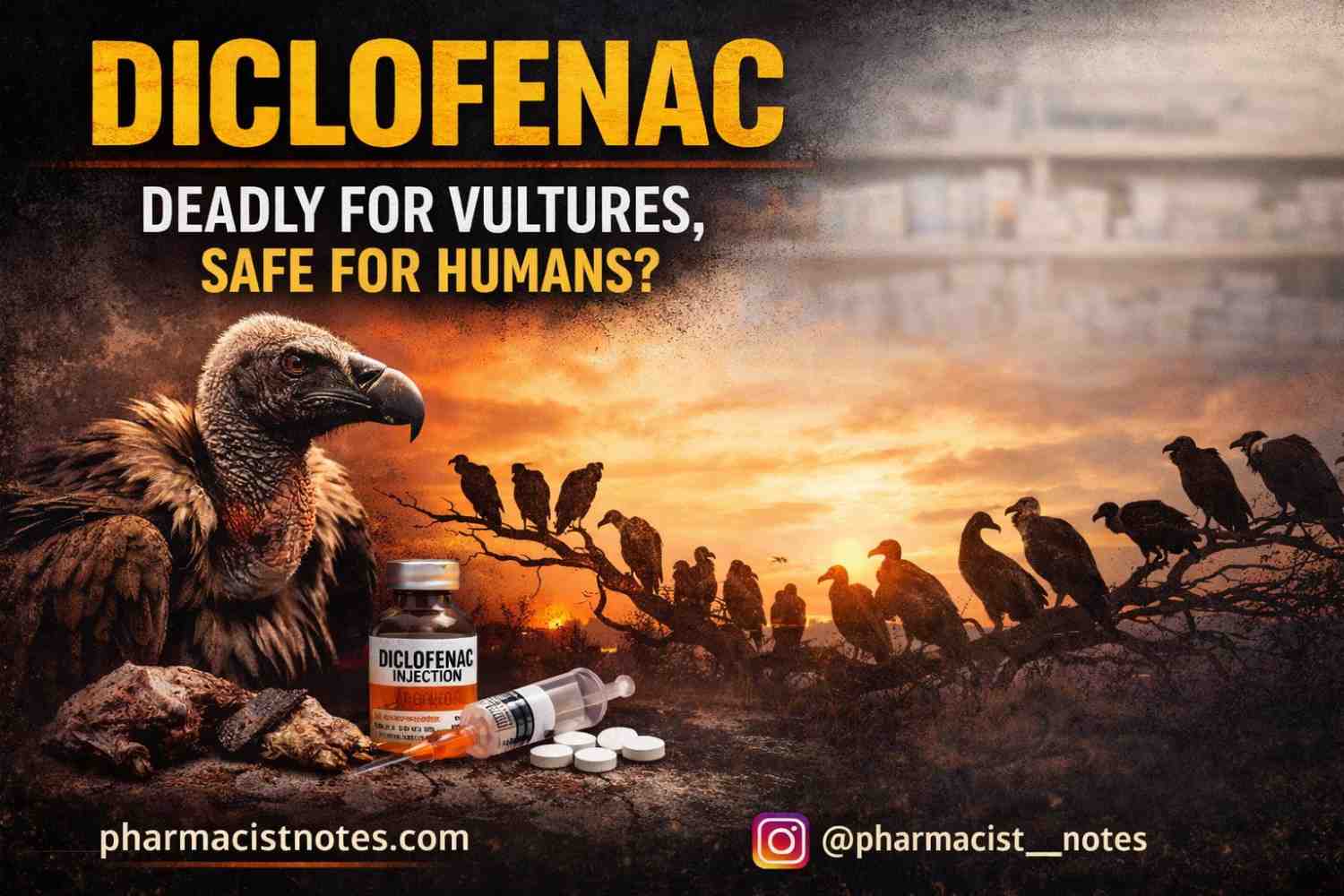
Diclofenac and the Indian vulture crisis
Diclofenac and dead vultures
Back in the 1990s, something very unusual started happening in India. Vultures, which were once seen everywhere, began disappearing rapidly.
At first, no one really understood what was going on.There were no obvious signs like mass poisoning or habitat destruction.
But one thing was clear vultures were dying in large numbers, and very quickly.

Scientists and researchers started investigating this sudden decline.
When they examined the dead vultures, they noticed something strange:
Their bodies showed signs of severe kidney failure, along with white deposits on organs — a condition known as visceral gout.
This raised an important question:
What is causing kidney failure in so many vultures?
After several studies, researchers finally found a common factor.
Many of the dead vultures had fed on cattle that were treated with Diclofenac, a commonly used veterinary painkiller.
Even small amounts of this drug were enough to cause fatal kidney damage in vultures.
Scientific confirmation
The breakthrough came when organizations like the Bombay Natural History Society and international researchers confirmed the link.
Their studies revealed that a commonly used NSAID, Diclofenac, was behind these deaths.
This same drug was widely used in both humans and cattle.
The problem started when cattle treated with diclofenac died, and vultures fed on their carcasses.
This discovery explained why vulture populations had crashed by over 95% in just a few years.
Does this pose any threat to humans?
This is the question that comes to almost everyone’s mind:
If diclofenac killed vultures, is it dangerous for us too?
Let’s talk about it in a simple way.
Diclofenac is a common painkiller (NSAID) that reduces pain and inflammation by blocking COX enzymes in the body.
But because of this mechanism, it can also have some effect on the kidneys — especially if used for a long time or in high doses.
You can read this article for more details on how NSAIDs works
Real life situation
Millions of people take diclofenac every day.
From my own experience working in a government hospital, we see around 1200 patients daily, and I personally dispense 300–400 tablets of diclofenac in a single day among these 1200 patients.
Now think about it —
if this drug was extremely dangerous for humans, it wouldn’t be used so commonly.
So what’s the truth?
Yes, it does affect the kidneys —
but not in the same deadly way as it does in vultures.
Most of us have taken it at some point.
For example, after an injury, it’s quite common to get a TT injection along with a diclofenac injection.
In normal prescribed doses, it is generally safe.
When should you be careful?
Problems usually happen when
- Someone takes it regularly without medical advice
- Uses it in high doses
- already has kidney issues
In these cases, yes it can harm the kidneys and can be fatal and it’s not only kidney which gets affected when you take NSAIDs
I already informed in another article that NSAIDs if taken for a longer period posses risk to not only your kidney, but heart, liver and even stomach too. If you are the one who is consuming any pain killer which belongs to NSAIDs category must read this article
Also in phase 3 trials diclofenac has shown good results, one such trial information is given here
But why vultures?
At this point, a natural question comes up:
Why only vultures?
And does diclofenac affect other animals in the same way?
Why are vultures so sensitive?
Vultures are scavengers meaning they feed on dead animals, especially cattle.
When cattle are treated with diclofenac and later die, small amounts of the drug remain in their body.
When vultures eat that meat, the drug enters their system.
The problem is Vultures cannot properly process (metabolize) diclofenac.
Even a very small amount can:
- Damage their kidneys
- Lead to a condition called visceral gout
- And cause death within a short time
That’s why the effect is so sudden and severe in vultures.
Is It only vultures?
Mostly, yes! Vultures are the most affected species.
But they are not the only ones.
Some other birds (like certain eagles or scavenging birds) may also be affected,
but vultures are extremely sensitive, which is why their population crashed so dramatically.
Other animals, including humans, do not show this level of extreme toxicity at normal exposure.
What’s the lesson?
So what do we actually learn from this whole story?
At first, it might feel shocking that a commonly used drug like diclofenac could wipe out millions of vultures.
But the real lesson is deeper than that.
A drug that is safe for humans may not be safe for other species.
Every species has a different way of handling chemicals in the body.
What works well in humans can turn out to be deadly for animals — just like it did for vultures.
Bigger picture
This incident teaches us something important:
Medicines don’t just affect patients, they can also impact the environment and the ecosystem. We saw the impact in this case, The population of vulture collapsed. The whole ecological balance was disturbed,
Responsibility in healthcare
As healthcare professionals, it’s not just about treating patients,
but also about understanding the wider impact of drugs.
That’s why, Drug safety matters, Proper use matters And awareness matters
Frequently Asked Questions (FAQs)
1. Why did diclofenac kill vultures?
Diclofenac becomes toxic for vultures when they consume carcasses of animals treated with this drug.
Even a small amount can cause severe kidney failure in vultures, which often leads to death
2. Is diclofenac dangerous for humans?
No, Not in the same way. Diclofenac is commonly used in humans for pain and inflammation, and it is generally safe when taken in proper doses under medical supervision. However, misuse or long-term use can affect the kidneys and stomach and sometimes heart & liver too
3. Why are vultures more sensitive than humans?
Vultures cannot properly process diclofenac in their bodies.
Because of this, even a very small dose becomes toxic for them, while humans can tolerate controlled doses.
4. Why was diclofenac banned for animals in India?
It was banned in 2006 after scientists confirmed that it was the main reason behind the massive decline in vulture populations in India.
5. What is the safer alternative to diclofenac for animals?
A safer alternative is meloxicam, which does not harm vultures and is now recommended for veterinary use.
6. Can humans take diclofenac safely?
Yes, but only in recommended doses. As i already mentioned in the article that, Daily consumption of diclofenac with ~1200 patient OPD is 300-400 tablets. but It should not be used regularly without medical advice, especially in people with kidney or stomach problems.
7. What is the main lesson from this case?
The key lesson is that a drug that is safe for humans may not be safe for other species.
It also highlights the importance of responsible drug use and understanding environmental impact.

