Table of Contents
Introduction – a patient I will not forget
Recently, I met a patient who was feeling strong “dizziness” — that just would not go away.
He had a history of chronic heart disease, and he also had a history of vertigo (BPPV – Benign Paroxysmal Positional Vertigo). So naturally, the first thought was that it must be one of these old problems coming back.
And that is exactly where the doctor started. One by one, the usual suspects were checked:
- Is it BPPV? — No.
- Is it some other vertigo / inner ear problem? — No.
- Is it cervical (neck-related)? — No.
- Is it his heart? — No.
None of them was the reason.
Then the doctor ordered a simple blood test — serum electrolytes.
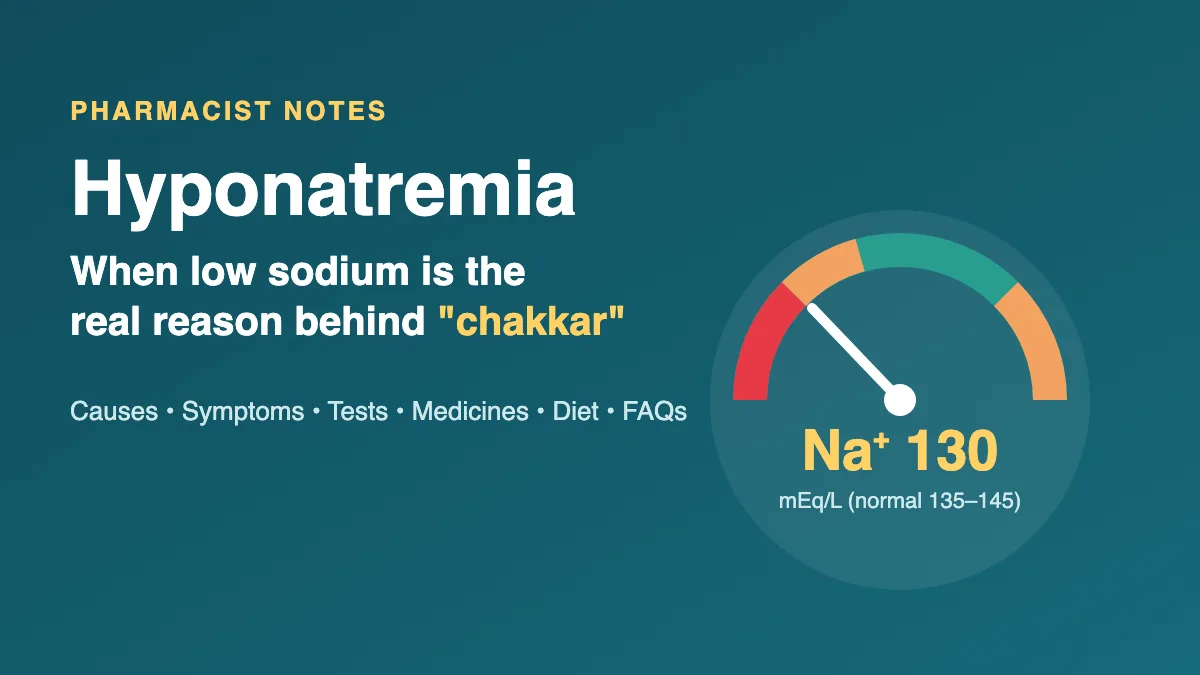
And there it was:
Not BPPV. Not vertigo. Not cervical. Not his heart. The real reason was low sodium — Hyponatremia.
That is exactly why I decided to write this article. Low sodium is very common, very easy to test, and very easy to miss — because its symptoms look like so many other problems.
So today, let’s understand Hyponatremia in simple words — what it is, why it happens, how it is tested, which medicines are used, and what you should eat (and avoid).
What is Hyponatremia?
Hyponatremia simply means low sodium in the blood.
- Hypo = low
- Natr = sodium (from “Natrium”, which is why sodium’s symbol is Na)
- Emia = in the blood
A normal blood sodium level is 135 to 145 mEq/L (also written as mmol/L — both are the same number for sodium). Anything below 135 is called hyponatremia.

| Sodium level (mEq/L) | Type | What it usually means |
|---|---|---|
| 135 – 145 | Normal | Water and salt are in balance |
| 130 – 134 | Mild | Dizziness, tiredness, poor focus, unsteady walk — often ignored |
| 125 – 129 | Moderate | Nausea, headache, confusion — needs medical attention |
| Below 125 | Severe | Vomiting, drowsiness, seizures — medical emergency |
Now here is the most important thing to understand
Most people think: “Low sodium means I am eating less salt.”
But in most cases, that is not the reason.
Let’s understand with a simple example.
Think of a glass of nimbu-pani (lemonade). If you keep adding water to it, the salt is still there — but it tastes less salty, because it is diluted. That is exactly what happens in your blood in most cases of hyponatremia.
This is also why the treatment is not always “eat more salt.” Sometimes, the treatment is actually drinking less water. We will come to this later.
Acute vs Chronic Hyponatremia
- Acute – sodium falls within 48 hours. The brain has no time to adjust, so symptoms are stronger and more dangerous.
- Chronic – sodium falls slowly over more than 48 hours (or the time is not known). The brain adapts, so symptoms are milder — but this also means it gets missed for a long time.
My patient’s sodium of 130 falls in the mild hyponatremia range — mild on paper, but enough to make him feel strong chakkar.
Why does low sodium make you dizzy?
Now let’s connect the dots.
Sodium is the main salt that holds water outside our cells. When sodium in the blood falls, the blood becomes “diluted,” and water starts moving into the cells — including brain cells.

The brain sits inside a hard skull. It does not have much space to swell. So even slight swelling can cause:
- dizziness and a feeling of imbalance
- headache
- nausea
- slow thinking, poor concentration
- in severe cases — confusion, seizures, and even coma
And this is not just theory. A well-known study published in the American Journal of Medicine (Renneboog et al., 2006) looked at patients with so-called “asymptomatic” mild chronic hyponatremia:
- About 21% of them came to the hospital because of a fall, compared to about 5% of people with normal sodium.
- They had more unsteady walking and slower attention — changes the researchers compared to the effect of drinking alcohol.
In simple words, “mild” low sodium is not always harmless, especially in elderly people. It can be the hidden reason behind dizziness, falls, and even fractures.
Symptoms of low sodium
Symptoms depend on two things: how low the sodium is, and how fast it fell.
Mild (often ignored)
- Dizziness / “chakkar”
- Tiredness, weakness, low energy
- Poor concentration, forgetfulness
- Unsteady walking, frequent near-falls
- Loss of appetite
- Muscle cramps
Moderate
- Nausea
- Headache
- Confusion, irritability
- Excessive sleepiness
Severe
- Repeated vomiting
- Severe confusion or drowsiness
- Seizures (fits)
- Breathing difficulty, coma
What causes Hyponatremia?
There are many causes, but let me explain the most common ones in simple language.

1. Water pills (Diuretics) — the most common medicine cause
Diuretics are given for high BP, heart failure and swelling. But they also remove sodium from the body.
- Thiazide-type diuretics — hydrochlorothiazide, chlorthalidone, indapamide, metolazone — are the biggest culprits.
- Loop diuretics (furosemide, torsemide) and spironolactone can also cause it, but less commonly.
Many popular BP combination tablets contain a thiazide — for example, Telmisartan + Hydrochlorothiazide, Olmesartan + Hydrochlorothiazide, Losartan + Hydrochlorothiazide, or Amlodipine + Indapamide. Patients often do not know there is a water pill inside their BP tablet.
Studies show thiazide-related hyponatremia is much more common in older people, especially women above 70–80 years. It can appear within weeks of starting the medicine — or years later, when something else (like heavy water drinking or a stomach infection) is added on top.
2. Heart failure
When the heart is weak, the body thinks there is “not enough blood” circulating. So it releases a water-holding hormone (ADH – antidiuretic hormone) and holds back extra water. This extra water dilutes the sodium.
Low sodium in heart failure patients is quite common (about 1 in 5 patients admitted to hospital with heart failure), and it is also a sign that the heart condition needs closer attention.
3. Drinking too much water
“Drink 4–5 litres of water daily” — this advice is everywhere on social media. For a healthy young person, the kidneys can usually handle it. But for someone who is elderly, on diuretics, or has heart or kidney disease, this can easily lead to low sodium.
The same can happen with marathon runners who drink only plain water, and with people who drink large amounts of beer (often called beer potomania).
4. Vomiting and loose motions
Here, the body actually loses salt along with water. If the person then drinks only plain water (and not ORS), the water gets replaced but the salt does not — and sodium falls.
5. SIADH (Syndrome of Inappropriate ADH)
This sounds complicated, but it is simple: the body makes too much water-holding hormone even when it does not need it. So the kidneys keep holding water, and sodium gets diluted.
Common triggers:
- Pneumonia and other lung infections
- Brain injury, stroke, meningitis
- Some cancers (especially small cell lung cancer)
- After surgery, pain, nausea
- Certain medicines (see below)
6. Other medicines that can lower sodium
| Medicine group | Examples |
|---|---|
| Antidepressants (SSRIs) | Escitalopram, sertraline, fluoxetine, paroxetine |
| Anti-epileptics | Carbamazepine, oxcarbazepine |
| Antipsychotics | Some drugs in this group |
| Hormone analogues | Desmopressin (used for bed-wetting, frequent urination at night) |
| Anticancer drugs | Cyclophosphamide, vincristine, cisplatin |
| Others | Opioid painkillers, and some reports with proton pump inhibitors (PPIs) and NSAIDs |
Elderly patients who are on a thiazide + an SSRI together are at an especially high risk. This is a combination I always pay extra attention to.
7. Kidney and liver disease
In chronic kidney disease, the kidneys cannot remove extra water properly. In liver cirrhosis, the body holds water (seen as ascites — fluid in the abdomen), which dilutes sodium.
8. Hormone problems
- Hypothyroidism (low thyroid) — especially when severe
- Adrenal insufficiency (low cortisol) — including in people who suddenly stop long-term steroid tablets
9. Very poor diet — “Tea and toast”
Some elderly people living alone eat very little — just tea, biscuits, or toast. The kidneys need some salt and protein from food to remove water properly. When food intake is too low, even normal amounts of water cannot be removed, and sodium falls.
A small but important point — “false” low sodium
Sometimes, the report shows low sodium but the real sodium is normal. This can happen when:
- Blood sugar is very high — high glucose pulls water into the blood and dilutes sodium. Once sugar is controlled, sodium usually comes back up.
- Very high triglycerides or proteins — this is called pseudohyponatremia, a lab-measurement effect.
That is why the doctor will often check sugar and other tests along with sodium.
Who is at higher risk?
- People above 65 years (especially women)
- People taking thiazide diuretics or BP combinations containing them
- Patients with heart failure, kidney disease or liver cirrhosis
- People on SSRIs, carbamazepine or oxcarbazepine
- People who drink very large amounts of water
- Elderly people with poor appetite or living alone
- Hospitalised patients — after surgery, with pneumonia or infections
- Endurance athletes (marathon, long cycling events)
Tests for Hyponatremia
The good news is — finding low sodium is very easy. A simple blood test does it. The harder part is finding why it is low. That is what the other tests are for.
| Test | Why it is done |
|---|---|
| Serum electrolytes (Sodium, Potassium, Chloride) | Confirms low sodium and shows if potassium is also disturbed (common with diuretics) |
| Blood sugar | Very high sugar can falsely lower sodium |
| Serum osmolality | Tells if the blood is truly “diluted” (true hyponatremia) or not |
| Urine osmolality | Shows whether the kidneys are holding water (high) or passing it out (low) |
| Urine sodium | Helps tell apart causes like diuretics/SIADH vs vomiting/low intake |
| Kidney function test (Urea, Creatinine) | Checks for kidney disease |
| Thyroid test (TSH) | Rules out low thyroid |
| Serum cortisol | Rules out adrenal problems |
| Liver function test, lipid profile | Checks liver disease and very high fats (pseudohyponatremia) |
| Chest X-ray / other scans (if needed) | To look for lung infection, tumour or brain cause in SIADH |
Along with tests, the doctor also checks your “fluid status” — are you dehydrated (dry tongue, low BP on standing), or overloaded with fluid (swelling in legs, breathlessness, fluid in abdomen), or neither? This one clinical check changes the treatment completely.
How is Hyponatremia treated? (Medicines)
Now this is something very important to understand.
Step 1 — Find and fix the cause
This alone solves most mild cases.
- If a thiazide diuretic is the cause → the doctor may stop it or switch to another BP medicine.
- If an SSRI or anti-epileptic is the cause → the doctor may change the medicine or dose.
- If it is vomiting/diarrhoea → treat the infection and replace salt and water.
- If it is low thyroid or low cortisol → replace the hormone.
- If it is excess water intake → reduce the water.
Step 2 — Fluid restriction
For hyponatremia caused by SIADH, heart failure, kidney or liver disease, the main treatment is often drinking less — usually around 800 mL to 1–1.5 litres per day, as advised by the doctor. (This includes tea, milk, soup, juice — everything liquid.)
It sounds strange — “less water for a sodium problem?” — but remember the nimbu-pani example. Less water = less dilution.
Step 3 — Medicines (when needed)
| Treatment | When it is used | Important points |
|---|---|---|
| ORS / Normal saline (0.9% NaCl) IV | When the person is dehydrated — vomiting, diarrhoea, too much diuretic | Not suitable in SIADH or heart failure with swelling |
| Sodium chloride tablets (salt tablets) | Mild–moderate SIADH, along with fluid restriction | Only on doctor’s advice — can worsen swelling/BP in heart patients |
| Oral urea | SIADH not responding to fluid restriction | Helps the kidneys pass out extra water; taste is unpleasant |
| Loop diuretic (furosemide) + salt | Selected SIADH or fluid-overload cases | Removes extra water; needs monitoring |
| Tolvaptan (vasopressin V2 receptor antagonist) | Hyponatremia due to SIADH or heart failure, when other measures fail | Must be started in hospital with close sodium monitoring; risk of liver injury; costly; not for long-term casual use |
| 3% Hypertonic saline IV | Severe symptoms — seizures, vomiting, severe confusion | Only in hospital/ICU, with sodium checked every few hours |
Very important: sodium must be corrected SLOWLY
This is where many people get it wrong — including some who try to fix it at home with lots of salt.
When sodium has been low for a while, the brain adjusts to it. If you raise the sodium too quickly, water rushes out of the brain cells, and this can damage the nerve coverings (myelin). This condition is called Osmotic Demyelination Syndrome (ODS). It can cause difficulty in speaking and swallowing, weakness, and in rare cases permanent damage.
Diet in Hyponatremia
This is the part where I see the most confusion.
When people hear “low sodium,” the first thing they do is start eating extra salt, pickles, namkeen. But the right diet depends on the cause.

1. If low sodium is due to vomiting or loose motions
- ORS (WHO formula, like Electral) — the best choice
- Salted rice kanji, dal water, soups
- Nimbu-pani with salt and sugar
- Khichdi, curd rice, salted buttermilk (chaas)
- Avoid drinking only plain water in large amounts
2. If you are a heart, kidney or liver patient
- Follow the fluid limit your doctor gives you — this is usually more important than salt
- Do not start salt tablets or extra salt on your own — it can increase swelling and breathlessness
- Avoid high-salt processed foods (pickles, papad, namkeen, instant noodles) — they add salt but also make you thirsty
- Weigh yourself daily — a sudden weight gain of 1–2 kg in 2–3 days usually means fluid build-up
3. If you are elderly, have SIADH, or are eating poorly
- Eat proper meals with protein at every meal — dal, paneer, eggs, curd, chicken, soya
- Use normal salt in food — avoid a “zero-salt” diet unless your doctor specifically says so
- Drink according to thirst and doctor’s advice — not “forced” litres of water
- Avoid replacing meals with only tea and biscuits
- Avoid alcohol, especially beer
What about coconut water?
Many people think coconut water is the best drink for “electrolytes.” It is good for potassium, but it is actually low in sodium. So it is not a good way to raise sodium. And heart or kidney patients on certain BP medicines (like ACE inhibitors, ARBs or spironolactone) should be careful with it because of its high potassium.
How to prevent low sodium
- Don’t over-drink water. Drink according to thirst, climate, and your doctor’s advice — not according to social media targets.
- Know your medicines. Ask your pharmacist: “Is there a water pill in my BP tablet?” Many combinations contain hydrochlorothiazide or indapamide.
- Get electrolytes checked after starting a thiazide or SSRI, especially if you are above 60 — and whenever you feel unusual dizziness, weakness or confusion.
- Use ORS, not plain water, during vomiting or loose motions.
- Don’t follow a “no salt at all” diet unless your doctor has asked you to. “Less salt” and “no salt” are very different things.
- Eat proper meals — especially elderly people living alone.
- During long exercise, use electrolyte drinks rather than only plain water.
- Never stop long-term steroids suddenly — always taper as advised.
- Heart failure patients: follow both your salt and fluid limits, and weigh yourself daily.
Red flag symptoms – seek medical help immediately
- repeated vomiting
- severe headache
- confusion, unusual drowsiness, or difficulty waking up
- seizures (fits)
- breathing difficulty
- a fall with head injury
Also remember: if dizziness comes with weakness on one side of the body, slurred speech, double vision or facial deviation, think of stroke first — call for emergency help right away.
Summary – the key takeaway
- Hyponatremia means blood sodium is below 135 mEq/L.
- In most cases, it is too much water, not too little salt.
- Even mild low sodium (130–134) can cause dizziness, poor balance, confusion and falls — especially in elderly people.
- Common causes: water pills (thiazides), heart failure, excess water drinking, vomiting/diarrhoea, SIADH, and medicines like SSRIs and carbamazepine.
- Diagnosis starts with a simple serum electrolytes test.
- Treatment is cause-specific — sometimes stopping a medicine, sometimes drinking less, sometimes salt, and in severe cases hospital treatment.
- Sodium must be corrected slowly — never try to fix severe low sodium at home.
- “More salt” is not right for everyone — especially heart, kidney and liver patients.
Frequently Asked Questions about Hyponatremia
1. What is hyponatremia?
Hyponatremia means the sodium level in your blood is below 135 mEq/L. Most of the time, it happens because there is too much water in the body compared to sodium — not simply because you eat less salt.
2. Can low sodium cause dizziness?
Yes. Even mild low sodium (130–134 mEq/L) can cause dizziness, unsteady walking, poor concentration and falls, especially in elderly people.
3. Is sodium 130 dangerous?
Sodium 130 is mild hyponatremia. It is usually not an emergency, but it should not be ignored. The cause must be found and corrected under a doctor’s guidance.
4. Which medicines cause low sodium?
Thiazide diuretics (hydrochlorothiazide, chlorthalidone, indapamide), SSRIs (escitalopram, sertraline), carbamazepine, oxcarbazepine, desmopressin, and some anticancer drugs are the common ones.
5. Should I eat more salt if my sodium is low?
Not always. If it is due to vomiting or loose motions, salt and ORS help. But in heart failure, kidney or liver disease, extra salt can worsen swelling and breathlessness. Always follow your doctor’s advice.
6. Can drinking too much water cause low sodium?
Yes. Drinking large amounts of water — especially if you are on diuretics, have heart failure, or during long exercise — can dilute the sodium in your blood.
7. How long does it take for sodium to become normal?
Mild cases usually improve over a few days to a couple of weeks once the cause is corrected. Severe cases are corrected slowly in hospital over several days.
8. How fast should sodium be corrected?
Slowly. Doctors usually avoid raising sodium by more than about 8–10 mEq/L in 24 hours, because very fast correction can damage the brain (osmotic demyelination syndrome).
9. Is coconut water good for low sodium?
Coconut water is high in potassium but low in sodium, so it is not a good way to raise sodium. ORS is a better option after vomiting or loose motions.
10. Can low sodium be mistaken for vertigo?
Yes. Low sodium can cause dizziness and imbalance that feels similar to vertigo. One clue: BPPV dizziness is usually triggered by head movement, while low-sodium dizziness is often present even at rest, along with tiredness, nausea or confusion.
11. Which test is done for low sodium?
A serum electrolytes blood test confirms it. To find the cause, doctors may also order blood sugar, serum and urine osmolality, urine sodium, kidney function, thyroid and cortisol tests.
12. Can low sodium come back?
Yes, if the cause continues — for example, if the same diuretic is restarted or excess water drinking continues. That is why regular electrolyte check-ups are important for high-risk people.
Disclaimer
This article is for educational and awareness purposes only. It is not a substitute for professional medical advice, diagnosis or treatment. Do not start, stop or change any medicine, salt intake or fluid intake without consulting your doctor. If you have symptoms of low sodium, please consult a qualified healthcare professional.
Where to Verify This Information
This article is a summary for education. Always confirm doses, interactions and safety with the official product label and current guidelines, and with your doctor or pharmacist:
- Official drug labels: DailyMed (US), CDSCO (India), EMA (Europe)
- Guidelines and health information: World Health Organization, MedlinePlus (NIH)
- Published research on this topic: search PubMed


3 thoughts on “Hyponatremia (Low Sodium): The Hidden Reason Behind Dizziness – Causes, Symptoms, Tests, Treatment & Diet”