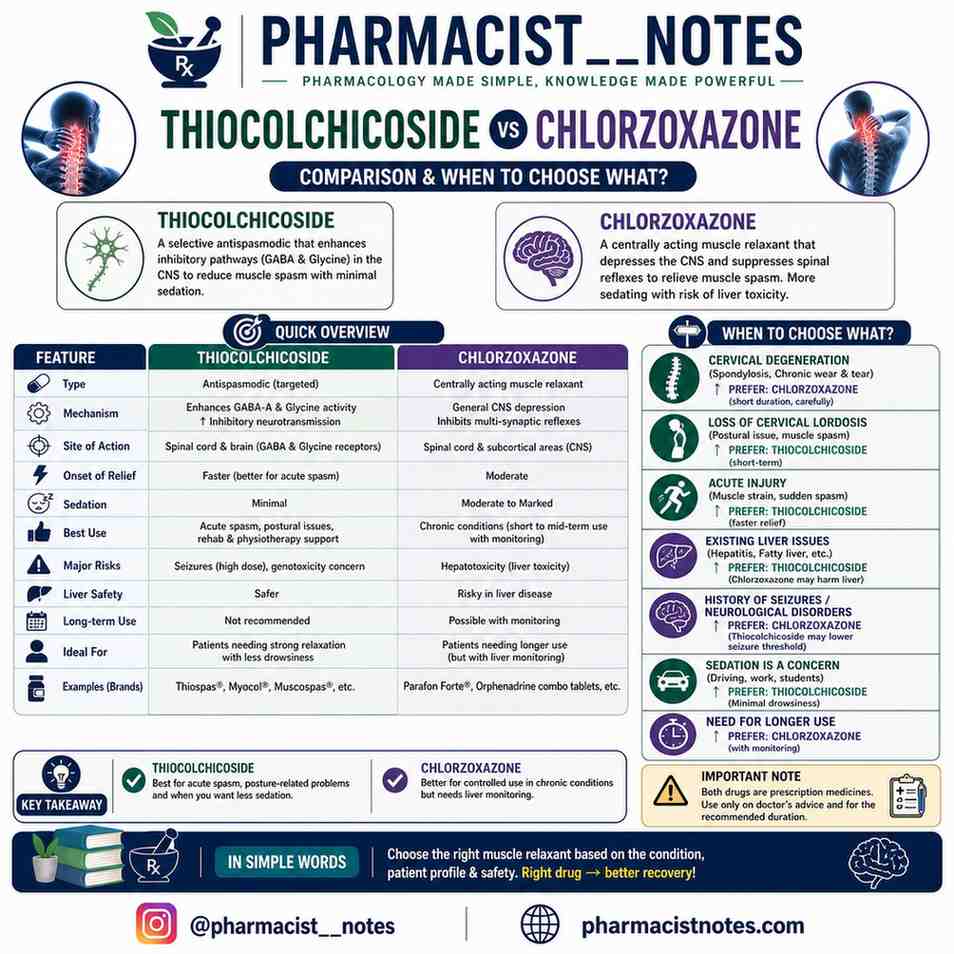
Thiocolchicoside vs Chlorzoxazone
Recently, I was discussing cervical issues with my colleagues—mainly problems caused by long sitting hours and poor posture. During the conversation, one of them asked a simple but important question: “Which medicine should we actually take for this?”
That’s when everyone started sharing their experiences—what medicines they were using and how effective they found them. As the discussion went on, we eventually landed on a common debate: Which one is better and safer—Thiocolchicoside or Chlorzoxazone?
If you’ve ever had the same question in mind, this article is for you.
Let’s break it down and understand how both Thiocolchicoside and Chlorzoxazone work.
How does Thiocolchicoside works ?
Let’s start with Thiocolchicoside.
Thiocolchicoside acts as an antispasmodic drug, which simply means it helps relieve muscle spasms. A muscle spasm is when a muscle suddenly tightens or contracts involuntarily, leading to pain and stiffness. In such situations, we need a muscle relaxant—and that’s exactly what Thiocolchicoside does.
Now, let’s understand how it works.
Thiocolchicoside acts on the GABA-A receptor. This is the same receptor where drugs like Alprazolam act, but the overall effect is not exactly the same.
In simple terms, the GABA-A receptor works like a “calming switch” in the brain and spinal cord. When it is activated, it slows down nerve activity. This means the overactive signals that are causing continuous muscle contraction are reduced.
Thiocolchicoside enhances this inhibitory (calming) effect. As a result, the excessive nerve signals going to the muscles decrease, allowing the muscles to relax. This helps in reducing both pain and stiffness.
An important point to note is that, unlike drugs such as Alprazolam, Thiocolchicoside does not cause significant sedation. So, it provides muscle relaxation without making the patient feel overly drowsy, which is a practical advantage in daily life.
Overall, Thiocolchicoside works by calming overactive nerve signals through the GABA-A pathway, leading to muscle relaxation and relief from spasm.
Now let’s go a little deeper into how Thiocolchicoside actually works inside the body.

Thiocolchicoside is a centrally acting muscle relaxant, which means it works mainly at the level of the brain and spinal cord—not directly on the muscle itself.
Its primary action is on inhibitory neurotransmitter systems, especially the GABA-A and glycine receptors.
1. Action on GABA-A receptors
GABA (gamma-aminobutyric acid) is the main inhibitory neurotransmitter in the central nervous system.
Normally:
- GABA binds to GABA-A receptors
- This opens chloride (Cl⁻) channels
- Chloride ions enter the neuron
- The neuron becomes more negative (hyperpolarized)
- As a result, nerve firing decreases
In simple words: GABA reduces overactive nerve signals
Thiocolchicoside interacts with these receptors and enhances inhibitory signaling (though not exactly like benzodiazepines). This helps in reducing excessive neuronal activity that is responsible for muscle contraction.
2. Action on Glycine receptors
This is equally important (and often overlooked).
Glycine is another inhibitory neurotransmitter, mainly active in the spinal cord.
Thiocolchicoside shows affinity for glycine receptors and modulates them, which:
- Decreases motor neuron excitability
- Reduces reflex muscle contraction
This is one of the key reasons why it works well in spinal muscle spasms.
3. Effect on spinal reflexes
Muscle spasms are often due to overactive spinal reflex arcs.
Thiocolchicoside:
- Reduces the excitability of motor neurons in the spinal cord
- Suppresses exaggerated reflex activity
Result: Muscles stop receiving continuous “contract” signals → relaxation happens
4. Overall effect
Because of these combined actions:
- Neuronal overactivity decreases
- Reflex muscle contraction is suppressed
- Muscle tone reduces
- Pain and stiffness improve
Important clinical note
Although it acts on GABA-related pathways, Thiocolchicoside:
- Does not produce strong sedation like benzodiazepines
- Has a different binding profile
However, at higher doses, there is a risk of:
- Seizures
- Neurotoxicity concerns
and this risk is what bother me and will come back to this later in the end of this article.
Common Brand Names of Thiocolchicoside (with NSAID combinations)
In real practice, Thiocolchicoside is rarely given alone. Most of the time, it is combined with an NSAID to provide both pain relief + muscle relaxation together.
Here are some commonly used combinations:
Myospaz-A, Zerodol-MR, Hifenac-MR, Movexx-MR, Voveran-MR, Liofen-MR, Diclo-MR, Etorica-MR, Nucoxia-MR
Final takeaway
Thiocolchicoside works by enhancing inhibitory pathways (GABA and glycine) in the central nervous system, which reduces excessive nerve signals to muscles and leads to effective muscle relaxation.
Now, let’s discuss the mechanism of action of Chlorzoxazone in similar way
How does Chlorzoxazone works?

Chlorzoxazone is also a centrally acting muscle relaxant, but its working style is a bit different from Thiocolchicoside.
It is mainly used to relieve muscle spasm associated with musculoskeletal conditions like cervical pain, back pain, or muscle strain.
Chlorzoxazone works primarily at the level of the spinal cord and subcortical areas of the brain.
Unlike Thiocolchicoside, it does not directly act on specific receptors like GABA-A or glycine in a very defined way. Instead, it produces a general depression of the central nervous system (CNS).
1. Suppression of spinal reflexes
Muscle spasm is often due to overactive reflex arcs in the spinal cord.
Chlorzoxazone:
- Inhibits multisynaptic reflexes
- Reduces transmission of nerve impulses
This decreases the signals that are continuously telling the muscle to contract
2. CNS depression effect
It has a mild CNS depressant action, which means:
- Neuronal activity slows down
- Pain perception reduces
- Muscle tone decreases
Result: muscles relax and spasm reduces
3. No direct action on muscle
Important point:
It does not act directly on skeletal muscle
It does not block neuromuscular junction
It works indirectly via CNS
4. Overall effect
Because of these actions:
- Spinal reflex activity decreases
- Muscle contraction signals reduce
- Muscle relaxes
- Pain and stiffness improve
Side effects (important for comparison)
- Drowsiness (common)
- Dizziness
- Hepatotoxicity (liver toxicity) which major concern in long-term use
Common Brand Names of Chlorzoxazone (with NSAID combinations)
Here are some commonly used combinations:
Aceclozox, Zox-A, Movexx-CZ, Myospaz Forte, Flexon mr, Parafon Forte etc
Final takeaway
Chlorzoxazone works by depressing the central nervous system and suppressing spinal reflexes, which reduces excessive nerve signals to muscles and leads to muscle relaxation.
Thiocolchicoside vs Chlorzoxazone — Comparison
Now that we’ve understood both drugs, let’s compare them in a practical as a doctor prescribing to his/her patients.
Both Thiocolchicoside and Chlorzoxazone are centrally acting muscle relaxants, but they differ in how they work and where they are preferred.
Thiocolchicoside mainly works by enhancing inhibitory pathways (GABA and glycine), which directly reduces muscle overactivity. Because of this, it often feels more “targeted” in relieving spasm without causing much sedation.
On the other hand, Chlorzoxazone works by generally depressing the central nervous system and suppressing spinal reflexes. It is effective, but it tends to cause more drowsiness and has a known risk of liver toxicity with prolonged use.
So, the real question is not just “which is better?”, but “which is better in which situation?”
When to choose what?
1. Cervical degeneration (spondylosis, long-term posture issues)
Prefer: Chlorzoxazone (short duration, carefully)
Reason: Chronic conditions often need safer long-term options. Thiocolchicoside is usually not preferred for prolonged use due to safety concerns (genotoxicity, seizure risk).
2. Loss of cervical lordosis (postural issue, muscle spasm dominant)
Prefer: Thiocolchicoside (short-term)
Reason: Strong muscle relaxation with less sedation → helps in posture correction exercises and physiotherapy.
3. Acute injury (muscle strain, sudden spasm)
Prefer: Thiocolchicoside
Reason: Faster and stronger relief from acute spasm.
4. If patient already has liver issues
Prefer: Thiocolchicoside (with caution)
Reason: Chlorzoxazone can cause hepatotoxicity thus should avoid in liver disease.
5. If patient is prone to seizures / neurological issues
Prefer: Chlorzoxazone
Reason: Thiocolchicoside may lower seizure threshold.
6. If sedation is a problem (working professional, driving etc.)
Prefer: Thiocolchicoside
Reason: Minimal drowsiness compared to Chlorzoxazone.
7. Long-term use requirement
Prefer: Chlorzoxazone (but monitored use)
Reason: Thiocolchicoside is generally restricted for short-term use.
Quick Comparison (Thiocolchicoside vs Chlorzoxazone)
| Feature | Thiocolchicoside | Chlorzoxazone |
|---|---|---|
| Type | Antispasmodic (targeted) | Centrally acting muscle relaxant |
| Mechanism | GABA-A & Glycine modulation | CNS depression + reflex suppression |
| Sedation | Minimal | Moderate |
| Onset of relief | Faster (acute spasm) | Moderate |
| Best use | Acute spasm, posture-related issues | Chronic conditions (short monitored use) |
| Major risk | Seizures, genotoxicity concern | Hepatotoxicity |
| Liver safety | Safer | Risky in liver disease |
| Long-term use | Not recommended | Possible with monitoring |
Final Takeaway from pharmacist
Important Safety Concern: Thiocolchicoside (Genotoxicity & Restrictions)
Before concluding that Thiocolchicoside is “safer,” there’s an important point you should definitely know.
Some studies have shown that Thiocolchicoside (especially its metabolite M2) may have genotoxic potential. In simple terms, this means it can potentially cause damage to DNA (genetic material).
Because of this concern, regulatory authorities in Europe, including the European Medicines Agency, reviewed its safety.
What restrictions were applied?
Due to this risk, strict guidelines were introduced:
- Use only for short duration (generally ≤ 7 days oral use)
- Avoid high doses
- Not recommended in pregnancy and breastfeeding
- Avoid in women of childbearing age without proper contraception
- Use cautiously due to risk of seizures
So, it is not completely banned, but its use is restricted and controlled.
Reference: https://www.ema.europa.eu/en/documents/referral/thiocolchicoside-article-31-referral-annex-ii_en.pdf
What does this mean in practice?
- Thiocolchicoside is effective, but not meant for long-term use
- It should be used only in acute muscle spasm cases
- Doctors usually prescribe it for a short course
Thiocolchicoside may look “safer” due to less sedation, but it carries serious long-term safety concerns such as genotoxicity and seizure risk.
That’s why its use is restricted in many countries.
This is exactly why comparing it with Chlorzoxazone becomes important, because less drowsiness does not always mean safer overall.
- Thiocolchicoside is better for acute spasm, posture-related problems, and when you want less sedation
- Chlorzoxazone is better for controlled use in chronic conditions but needs liver monitoring
There is no “one best drug” — it always depends on the patient, condition, and duration of use.
Disclaimer
These are prescription drugs. Always consult a doctor before starting or switching medication, especially if you have existing medical conditions.
Conclusion
I hope this article helped you clearly understand the difference between Thiocolchicoside and Chlorzoxazone, How does Thiocolchicoside works, Chlorzoxazone uses and side effects and when each one may be a better choice.
The key point to remember is that there is no single “best” drug for everyone. The right option always depends on the condition, severity of symptoms, and the patient’s overall health.
Muscle spasm treatment drugs like Thiocolchicoside may be more suitable for short-term relief of acute muscle spasm with less sedation, while other Muscle spasm treatment drugs like Chlorzoxazone can be considered in certain cases with proper monitoring, especially keeping its liver-related risks in mind.
Instead of choosing a medicine on your own, it is always better to understand the situation and consult a healthcare professional before starting any treatment.
If you found this helpful, you can share it with someone who might be dealing with similar muscle or cervical issues.