Table of Contents

Introduction
Many people ask me, “Does levocetirizine cause sleep?”
You might have also noticed that when doctors prescribe this medicine, they often write “HS”, which means to be taken at bedtime.
This naturally makes people wonder:
“Will it make me sleepy if I take it during the day?”
The answer is yes — but only to a small extent.
Compared to older antihistamines, levocetirizine causes much less drowsiness, though some people may still feel slightly sleepy.
In this article, I’ll answer all your common questions about levocetirizine — A medicine you might know by brand names like Okacet, Cetcip, Alerid, Cetzine, Zyrtec, or Zirtek.
Medicine Name
Levocetirizine
Levocetirizine drug class
Levocetirizine belongs to a group of medicines called second-generation antihistamines.
In simple terms, it works by blocking H1 histamine receptors, which are responsible for causing allergy symptoms like sneezing, itching, and runny nose.
Unlike older (first-generation) antihistamines (like diphenhydramine, chlorpheniramine etc), Levocetirizine causes less drowsiness and is generally better tolerated in day-to-day use.
Brand Names
India:
Okacet, Cetcip, Alerid, Cetzine
USA
Zyrtec
UK / Europe:
Piriteze, Zirtek
Approved By
- FDA (United States)
- CDSCO (India)
Available Strengths & Dosage Forms
This medicine is available in tablets, syrup, and oral drops (for children), so it can be used easily across different age groups.
- Tablet: Levocetirizine 5 mg, 10 mg tablets
- Syrup: 5mg / 5ml
- Oral drops (paediatric use)
Purpose / Indications
Levocetirizine is commonly used to treat allergic conditions by reducing the effects of histamine — the chemical in the body that causes allergy symptoms.
In simple terms, It helps control symptoms like sneezing, itching, and runny nose that happen during an allergic reaction.
Where is it commonly used?
Levocetirizine is prescribed in conditions like:
Post-nasal drip and nasal congestion caused by allergy
Allergic rhinitis (seasonal or year-round allergy)
Sneezing and runny nose due to cold or allergy
Urticaria (hives) – itching and raised skin rashes
Skin allergies – itching, redness, irritation
Watery or itchy eyes
This is the same medicine that is often given when you visit a chemist or doctor for:
- Continuous sneezing
- Cold with allergy
- Itchy skin or rashes
It doesn’t cure the root cause of allergy,
but it effectively controls the symptoms, making you feel comfortable.
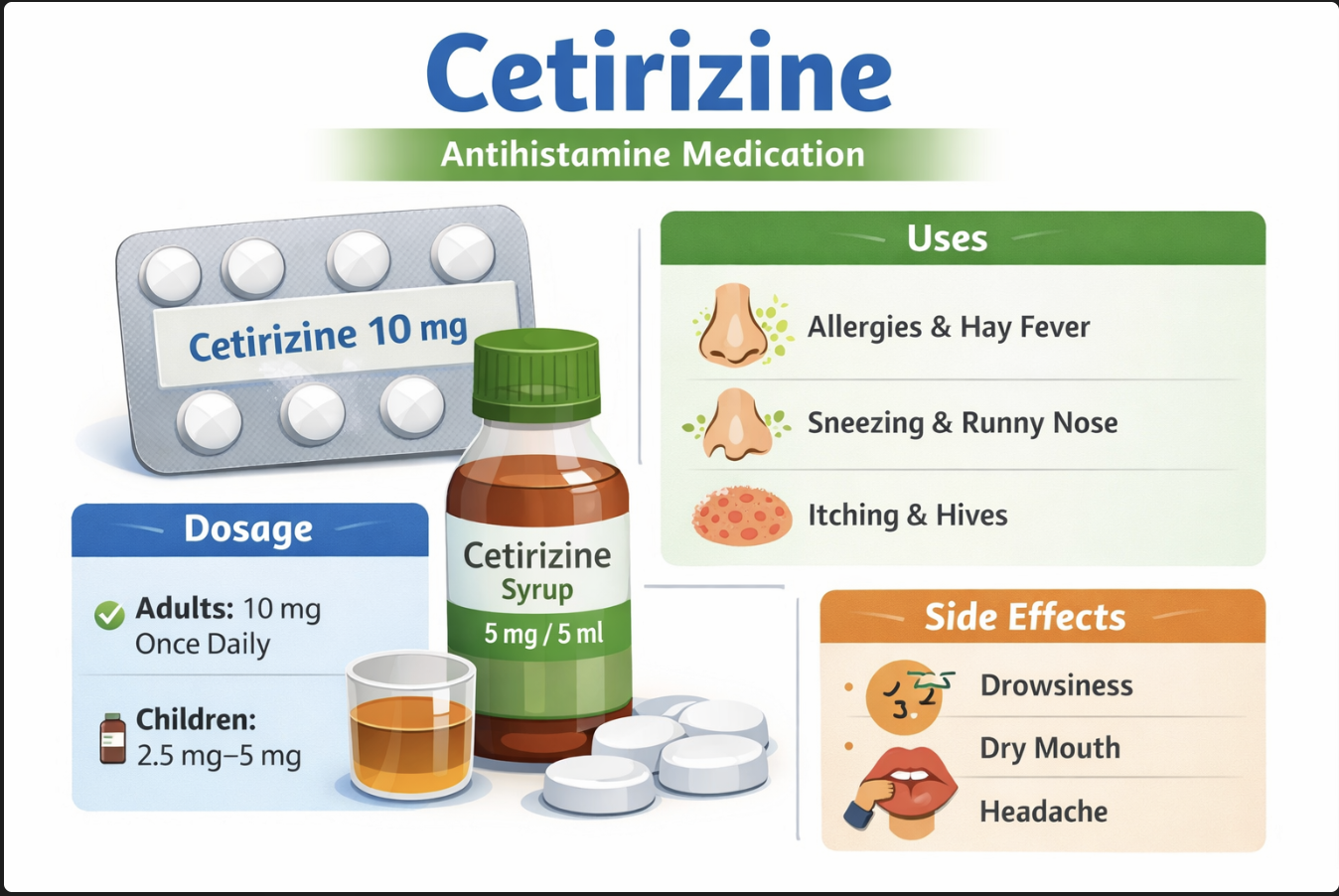
Symptoms Cetirizine May Cure
- Sneezing
- Runny or blocked nose
- Itching (skin, eyes, nose)
- Watery eyes
- Urticaria (hives)
- Allergic skin rashes
- Post-nasal drip
- Nasal congestion due to allergy
- Redness of eyes
- Swelling in allergic reactions
Dosage
Adults
- 5–10 mg once daily (OD)
Children
- 2–5 years: 2.5 mg once daily
- 6 years & above: 5–10 mg once daily
Dose should be adjusted as directed by a physician.
Mechanism of Action
Levocetirizine works by selectively blocking peripheral H1 histamine receptors.
In simple terms, it prevents histamine (the chemical responsible for allergy) from acting on the body.
Because of this:
- Itching is reduced
- Sneezing decreases
- Runny nose improves
- Swelling and redness are controlled
It also has minimal penetration into the brain, which is why it causes less drowsiness compared to older antihistamines..
Step-by-step explanation:
- During an allergic reaction, the body releases histamine from mast cells and basophils.
- Histamine binds to H1 receptors in the body, which leads to:
- Vasodilation (widening if blood vessles)
- Increased capillary permeability
- Symptoms such as itching, redness, sneezing, and increased mucus secretion
- Cetirizine prevents histamine from binding to H1 receptors, thereby blocking its effects.
- As a result:
- Itching and redness are reduced
- Sneezing and runny nose are controlled
- Swelling in conditions like urticaria (hives) decreases
Additional pharmacological points:
- Levocetirizine mainly acts on peripheral H1 receptors and has minimal penetration across the blood–brain barrier, which explains its lower sedative effect compared to first-generation antihistamines.
- It inhibits histamine-induced vascular permeability and sensory nerve stimulation, helping control allergic symptoms.
- Levocetirizine also exhibits a mild anti-inflammatory effect, which contributes to symptom relief during the late phase of allergic reactions.
Summary statement:
Levocetirizine blocks H1 histamine receptors, thereby preventing histamine-mediated allergic symptoms such as itching, sneezing, redness, and swelling, with minimal central nervous system effects.
Side Effects
Common Side Effects
- Drowsiness
- Dry mouth
- Fatigue
Less Common / Rare
- Headache
- Dizziness
- Gastrointestinal discomfort
Contraindications
- Known hypersensitivity to cetirizine or hydroxyzine
- Severe renal impairment (use with caution)
Dosage Frequency
- Usually taken once daily (OD)
- Preferably in the evening if drowsiness occurs
In patients where pain or inflammation is a dominant symptom, antihistamines like cetirizine may be used along with other drug classes such as analgesics or NSAIDs, depending on the clinical condition.
Use in Special Populations
Pregnancy
- Generally considered safe (Category B)
As per US FDA - Use only if clearly needed and prescribed
A drug is placed in Category B when animal reproductive studies have not shown a risk to the fetus, but there are no adequate and well-controlled studies in pregnant women. That means:
- Animal studies: Did not show evidence that the medicine causes fetal harm.
- Human data: Not enough good studies yet to confirm whether it’s absolutely safe or risky.
So Category B suggests the medicine may be safer than other categories, but this is not a guarantee—doctors still use it only if benefits outweigh potential risks.
Lactation
- Small amounts may pass into breast milk
- Use with caution
Elderly
- Dose adjustment may be required in renal impairment
Drug Interactions
- Alcohol (may increase drowsiness)
- CNS depressants (sedatives, sleeping pills)
Storage Instructions
- Store at room temperature
- Keep away from moisture and direct sunlight
- Keep out of reach of children
How Levocetirizine is different form cetirizine
Many people think levocetirizine and cetirizine are completely different medicines, but in reality, they are closely related.
Levocetirizine is actually the active part (R-enantiomer) of cetirizine.
This means it is a more refined version of cetirizine.
So what’s the practical difference?
- Levocetirizine works more efficiently at a lower dose
- It is generally considered to cause less drowsiness
- It may provide better symptom relief in some patients
On the other hand, cetirizine is still effective and widely used
Is slightly more likely to cause sleepiness
Disclaimer
This information is for educational purposes only and should not be used as a substitute for professional medical advice. Always consult a doctor or pharmacist before using any medication.


4 thoughts on “Does Levocetirizine 5mg cause sleepiness? Know its Uses, Dosage & Side Effects”