Table of Contents
Levocetirizine vs Cetirizine
Cetirizine and levocetirizine are second-generation antihistamines used to treat allergic rhinitis, urticaria, and other allergic conditions. Cetirizine was developed first, and levocetirizine was later introduced as an improved version containing only the active form of the drug.
Both drugs block H1 histamine receptors, but levocetirizine is considered more potent and causes less sedation.Here in this article we will compare Levocetirizine vs Cetirizine
History and Development
History of Cetirizine
Cetirizine came first as brand name Zyrtec
1983, Cetirizine is patented by UCB Pharma(Union Chimique Belge), Belgium
1987, Approved in Europe
1995, Approved in USA as prescription drug
2007, Approved in USA as OTC drug and patent expired for cetirizine
Cetirizine was designed to replace first-generation antihistamines like diphenhydramine, which caused excessive sedation.
History of Levocetirizine
1992, Patent for Levocetirizine was filed by UCB Pharma
2001, Levocetirizine was approved in Europe
2007, Approved in USA
Levocetirizine is more effective than cetirizine and here is why?
Understanding the Concept of Enantiomers
Many drugs exist in two mirror-image forms called enantiomers, known as the R-enantiomer and S-enantiomer. These forms have the same chemical formula but differ in their three-dimensional orientation. Because biological receptors are highly selective, often only one enantiomer produces the desired therapeutic effect.
Cetirizine is a classic example of such a drug.
Cetirizine is a Racemic Mixture
Cetirizine is a racemic mixture, meaning it contains equal amounts of two enantiomers:
- R-enantiomer (Levocetirizine) → pharmacologically active
- S-enantiomer (Dextrocetirizine) → minimally active or inactive
This means:
10 mg Cetirizine contains:
- 5 mg Levocetirizine (active component)
- 5 mg inactive or less active component
The inactive enantiomer does not contribute significantly to antihistamine activity but still enters the body and undergoes metabolism.
Levocetirizine Contains Only the Active Enantiomer
Levocetirizine is the pure R-enantiomer of cetirizine. It contains only the pharmacologically active form responsible for blocking histamine H1 receptors.
Because it contains 100% active drug, levocetirizine provides:
- Greater receptor binding efficiency
- Improved therapeutic effect
- Lower required dose
- Reduced exposure to inactive drug
This is why the standard dose of levocetirizine is 5 mg, compared to 10 mg for cetirizine, while providing equal or superior effectiveness.
Mechanism: Why the R-Enantiomer is Better
Histamine produces allergy symptoms by binding to H1 receptors located in:
- Skin
- Respiratory tract
- Blood vessels
- Nasal mucosa
Levocetirizine selectively binds to these H1 receptors and blocks histamine action, preventing symptoms such as:
- Sneezing
- Itching
- Runny nose
- Urticaria (hives)
The S-enantiomer has significantly lower affinity for H1 receptors and therefore contributes minimally to antihistamine activity.
Because levocetirizine contains only the active R-enantiomer, it binds more efficiently and produces stronger antihistaminic effects.

Pharmacological Advantages of Levocetirizine
Compared to cetirizine, levocetirizine offers several pharmacological advantages:
1. Higher Receptor Affinity
Levocetirizine has a stronger and more selective binding to peripheral H1 receptors, resulting in more effective histamine blockade.
2. Greater Potency
Levocetirizine is approximately twice as potent as cetirizine, which is why half the dose provides equivalent or better clinical effect.
Therefore, 5 mg Levocetirizine ≈ 10 mg Cetirizine
3. Improved Clinical Efficacy
Clinical studies have shown that levocetirizine provides:
- Faster symptom relief
- Better control of allergic rhinitis
- Improved management of chronic urticaria
4. Reduced Exposure to Inactive Component
Since levocetirizine does not contain the inactive S-enantiomer, the body is exposed only to the effective drug, improving pharmacological efficiency.
5. Lower Risk of Side Effect
Because levocetirizine is more selective and efficient, it may produce:
- Less sedation
- Better tolerability
- Improved safety profile
Although both drugs are considered low-sedating antihistamines, levocetirizine is generally preferred when minimal sedation is required.
Chiral Switching: Why Levocetirizine Was Developed
The development of levocetirizine from cetirizine is an example of chiral switching, a process in which the active enantiomer of an existing drug is isolated and marketed as a separate medication.
The goals of chiral switching include:
- Improved efficacy
- Reduced side effects
- Lower dose requirement
- Better receptor selectivity
Levocetirizine represents the optimized active form of cetirizine.
Summary
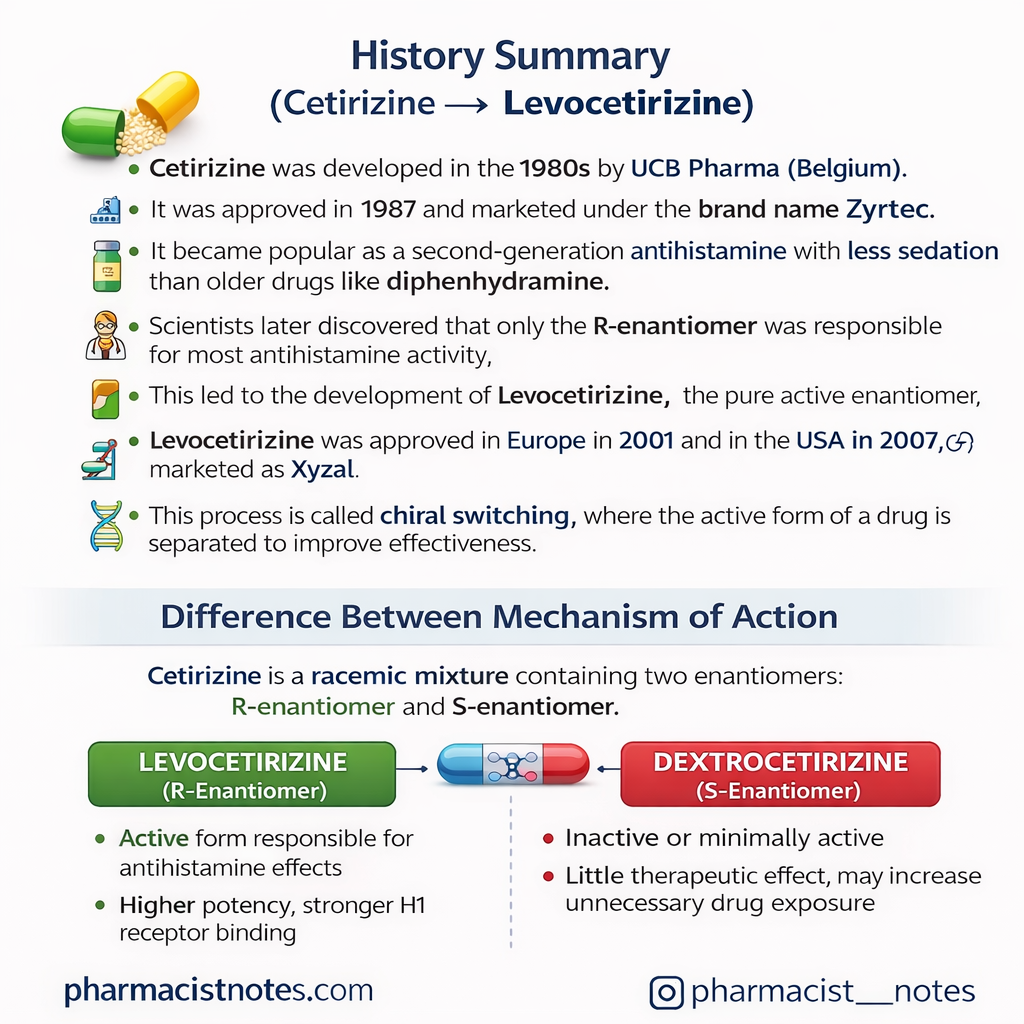
History Summary (Cetirizine → Levocetirizine)
- Cetirizine was developed in the 1980s by UCB Pharma (Belgium).
- It was approved in 1987 and marketed under the brand name Zyrtec.
- It became popular as a second-generation antihistamine with less sedation than older drugs like diphenhydramine.
- Scientists later discovered that only the R-enantiomer was responsible for most antihistamine activity.
- This led to the development of Levocetirizine, the pure active enantiomer.
- Levocetirizine was approved in Europe in 2001 and in the USA in 2007, marketed as Xyzal.
- This process is called chiral switching, where the active form of a drug is separated to improve effectiveness.
Difference between Mechanism of Action
- Cetirizine is a racemic mixture containing two enantiomers: R-enantiomer and S-enantiomer.
- Levocetirizine (R-enantiomer) is the active form responsible for antihistamine effects.
- It has higher potency, stronger H1 receptor binding, and less sedation.
- Dextrocetirizine (S-enantiomer) is inactive or minimally active.
- It contributes little to therapeutic effect and may increase unnecessary drug exposure.
- Levocetirizine was developed by isolating the active enantiomer to improve efficacy and safety.
Comparison
Which is Better for Allergy?
Levocetirizine is preferred for:
- Chronic urticaria
- Moderate allergy
- Daytime use
Cetirizine preferred for:
- Mild allergy
- Cost-sensitive patients
Side Effects Comparison
Cetirizine:
- Drowsiness (more common)
- Fatigue
Levocetirizine:
- Less sedation
- Better tolerability
| Feature | Cetirizine | Levocetirizine |
|---|---|---|
| Generation | Second | Second |
| Dose | 10 mg | 5 mg |
| Sedation | More | Less |
| Active form | Mixed | Pure |
| Potency | Lower | Higher |
Conclusion
Levocetirizine is more potent, causes less sedation, and provides better symptom control compared to cetirizine. However, cetirizine remains widely used due to lower cost.


One thought on “Levocetirizine vs Cetirizine: Differences, History, Mechanism and Which is Better”