Table of Contents
Introduction
H3 histamine blockers are drugs that act on H₃ receptors in the central nervous system (CNS). Unlike H1 and H2 blockers, which treat allergies and acid disorders, H₃ blockers primarily affect neurotransmitter release in the brain.
They are mainly used in neurological disorders such as narcolepsy (Narcolepsy is a chronic neurological disorder that affects the brain’s ability to control sleep-wake cycles.).
What are H₃ Receptors
H₃ receptors are special histamine receptors located in the brain and nervous system.
Their main function is to regulate the release of neurotransmitters such as:
- Histamine
- Dopamine
- Acetylcholine
- Norepinephrine
H₃ receptors act as inhibitory autoreceptors.
This means they reduce neurotransmitter release.
Location of H₃ Receptors
H₃ receptors are mainly present in:
- Brain (central nervous system)
- Hypothalamus
- Neurons
Mechanism of Action

Problem: Reduced brain histamine causes sleepiness and poor alertness
In the brain, histamine acts as an important neurotransmitter that maintains:
- Wakefulness
- Alertness
- Attention
- Cognitive function
Histamine is released from specialized neurons located in the hypothalamus.
When sufficient histamine is released, the brain remains alert and awake.
However, in certain conditions such as narcolepsy and excessive daytime sleepiness, histamine release in the brain becomes reduced.
This leads to symptoms such as:
- Excessive sleepiness
- Reduced alertness
- Poor concentration
- Fatigue
Cause: H₃ receptors reduce histamine release
H₃ receptors are located on histamine-releasing neurons in the brain.
These receptors function as inhibitory autoreceptors.
When H₃ receptors are activated, they send a signal to the neuron to reduce histamine release.
This results in:
Reduced histamine levels in the brain
Reduced stimulation of wakefulness centers
Increased sleepiness and decreased alertness
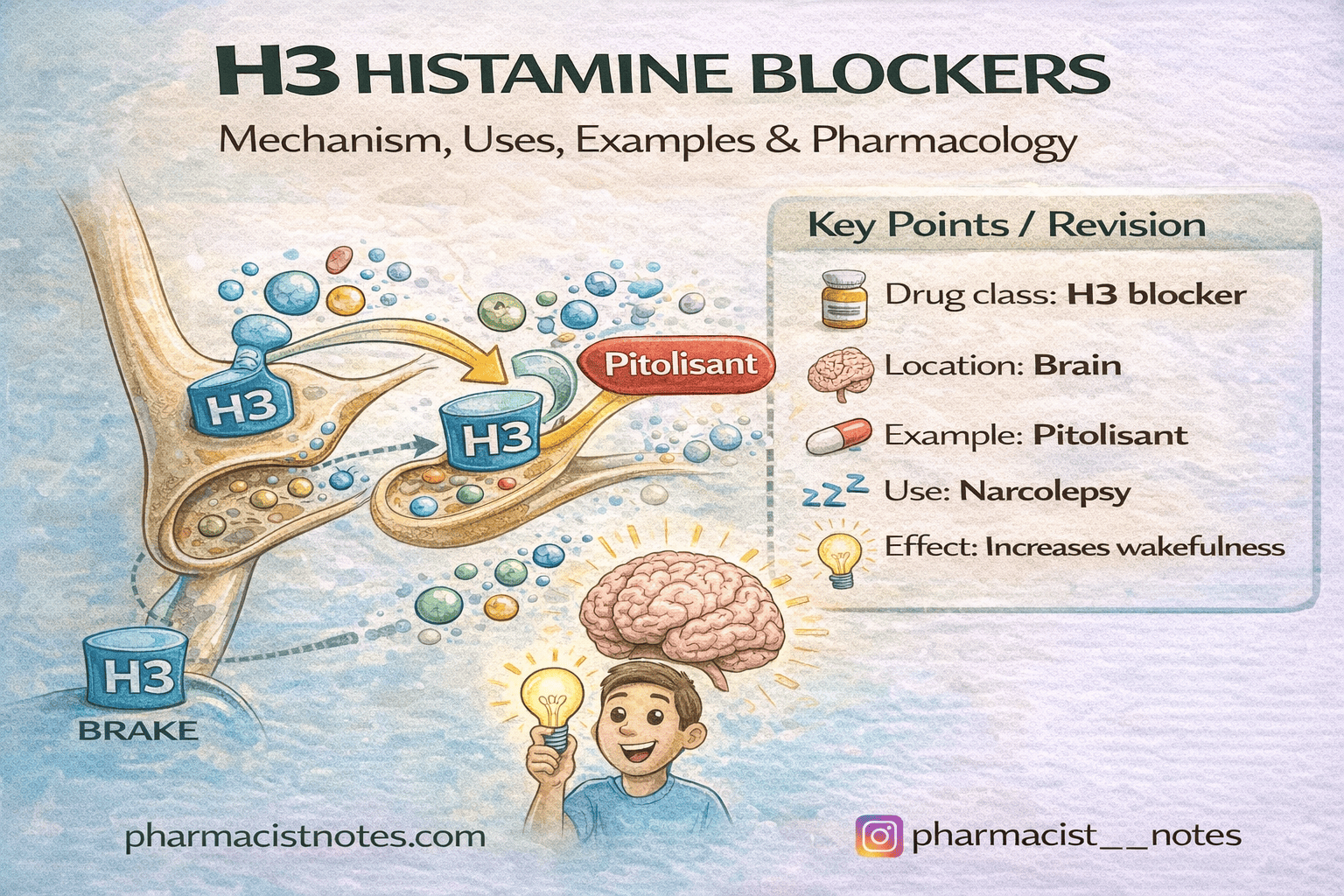
In simple terms, H₃ receptors act like a brake that limits histamine release.
Solution: Blocking H₃ receptors increases histamine release
To improve alertness, histamine release in the brain must be increased.
This can be achieved by blocking H₃ receptors.
When H₃ receptors are blocked:
- The inhibitory signal is removed
- Histamine release increases
- Brain activity increases
- Wakefulness and alertness improve
In addition to histamine, the release of other neurotransmitters also increases, including:
- Dopamine
- Acetylcholine
- Norepinephrine
These neurotransmitters further improve cognitive function and alertness.
Drug Example: Pitolisant (H3 receptor blocker)
Pitolisant is a selective H3 receptor blocker.
Mechanism:
Pitolisant blocks H3 receptors → removes inhibition on histamine neurons → increases histamine release → improves wakefulness.
Clinical effect:
- Improves alertness
- Reduces excessive daytime sleepiness
- Used in narcolepsy treatment
Summary Statement
H₃ receptor blockers such as pitolisant improve wakefulness by blocking inhibitory H₃ autoreceptors in the brain. This increases histamine release and enhances neurotransmitter activity, resulting in improved alertness and cognitive function.
Examples of H₃ Blockers
Pitolisant
Brand name:
Wakix
Pitolisant is the most important H₃ blocker.
Uses
H₃ blockers are used in:
Narcolepsy
Excessive daytime sleepiness
They help increase wakefulness.
Side Effects
Common side effects:
- Insomnia
- Headache
- Nausea
- Anxiety
Key Points / Revision – H₃ Receptor Blockers
H₃ receptor blockers are drugs that act on histamine H₃ receptors located primarily in the brain. These receptors regulate the release of histamine and other neurotransmitters involved in wakefulness and alertness. Blocking H₃ receptors increases histamine release in the brain, which promotes wakefulness. These drugs are mainly used to treat narcolepsy, a condition characterized by excessive daytime sleepiness. Pitolisant is a commonly used H₃ receptor antagonist.
| Point | Details |
|---|---|
| Drug Class | H₃ receptor antagonist (H₃ blocker) |
| Receptor Location | Brain (central nervous system) |
| Mechanism of Action | Blocks H₃ receptors → increases histamine release |
| Main Effect | Promotes wakefulness and alertness |
| Primary Use | Narcolepsy (excessive daytime sleepiness) |
| Example | Pitolisant |
| CNS Effect | Stimulates central nervous system indirectly |
FAQs
1. If H3 blockers increase histamine release, why don’t they cause allergy symptoms?
H3 blockers increase histamine release only in the brain, not in peripheral tissues like skin, nose, or lungs. Allergy symptoms occur when histamine is released from mast cells in peripheral tissues and activates H1 receptors. H3 receptors are located on neurons in the brain, so blocking them increases brain histamine and improves wakefulness without causing allergy symptoms.
2. Do H1 and H2 receptors release histamine or use histamine?
H1 and H2 receptors do not release histamine. They receive and respond to histamine. These receptors are called postsynaptic receptors. When histamine binds to H1 receptors, it causes allergy symptoms, and when it binds to H2 receptors, it increases stomach acid secretion.
3. Does the H3 receptor release histamine?
The H3 receptor does not release histamine directly. It regulates histamine release from neurons. H3 receptors act as inhibitory autoreceptors. When activated, they reduce histamine release, and when blocked, they increase histamine release in the brain.
4. Why are H3 receptor blockers used in narcolepsy?
H3 receptor blockers increase histamine release in the brain, which improves wakefulness and alertness. Histamine is an important neurotransmitter that keeps the brain awake. Blocking H3 receptors removes inhibition and increases histamine levels, helping treat excessive daytime sleepiness in narcolepsy.
5. What is an example of an H3 receptor blocker?
Pitolisant is the most important and clinically used H3 receptor blocker. It is used to treat narcolepsy and works by increasing histamine release in the brain, improving alertness and cognitive function.

