Table of Contents
Disclaimer
The information provided in this article is for educational and informational purposes only. It is not intended to substitute professional medical advice, diagnosis, or treatment. Drug safety in pregnancy and lactation can vary depending on individual health conditions, trimester, dosage, and clinical history. Always consult a qualified doctor, obstetrician, or healthcare provider before starting, stopping, or changing any medication during pregnancy or breastfeeding. The author and publisher are not responsible for any adverse effects resulting from the use of the information presented here.
Pregnancy Drug Risk Categories – What Do They Mean?
Earlier, the US FDA used letter categories (A, B, C, D, X) to classify drug safety in pregnancy. Although this system has now been replaced by the Pregnancy and Lactation Labeling Rule (PLLR), these categories are still commonly referenced in textbooks and exams.
More information here https://www.fda.gov/drugs/labeling-information-drug-products/pregnancy-and-lactation-labeling-resources
Older categories explained
Category A -Safest
- Controlled human studies show no risk
- Safest category
- Very few drugs fall here
Category B
- Animal studies show no risk
OR - Animal studies show risk but human studies do not
- Generally considered relatively safe
Category C
- Animal studies show adverse effects
- No adequate human studies
- Use only if benefits outweigh risks
Category D
- Positive evidence of human fetal risk
- May be used in life-threatening situations
Category X – Most Unsafe
- Proven fetal abnormalities
- Contraindicated in pregnancy
PLLR (Pregnancy and Lactation Labeling Rule)
PLLR Includes 3 Main Sections:
Pregnancy
- Risk summary
- Human and animal data
- Clinical considerations
Lactation
- Whether the drug passes into breast milk
- Potential effects on the infant
Females and Males of Reproductive Potential
- Contraception recommendations
- Fertility considerations
General Risks of Antihistamines in Pregnancy & Lactation

Before discussing individual drugs, let’s understand possible risks of Antihistamines in Pregnancy.
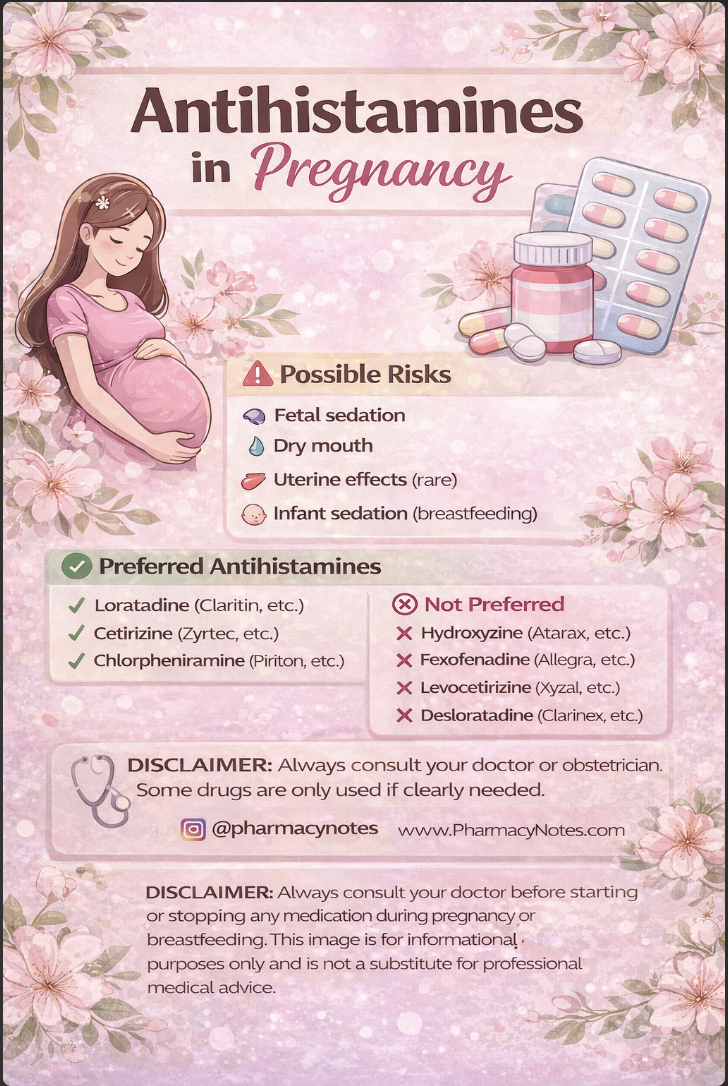
Possible Risks During Pregnancy
- Fetal sedation
- Anticholinergic effects
- Possible association with congenital defects
- Uterine stimulation
- QT prolongation (effect on heart rate)
Risks During Lactation (Breastfeeding)
- Infant sedation
- Irritability
- Reduced milk supply (especially sedating antihistamines)
- Dry mouth & feeding difficulty in infant
Second-generation antihistamines are generally preferred in lactation because they cause less sedation.
Individual Drug Safety Overview for Antihistamines in Pregnancy
Levocetirizine
Risks:
- Limited human pregnancy data
- Possible mild sedation
- Minimal data in breastfeeding
Safe Aspects:
- Second-generation (less CNS penetration)
- No clear teratogenic evidence
Final Category:
- Similar to Category B/C (data limited)
- ⚠️ Use if clearly needed
- Not first-line but acceptable
Cetirizine
Risks:
- Mild drowsiness
- Limited but reassuring pregnancy data
Safe Aspects:
- Well-studied
- Commonly used in pregnancy
- Low breast milk transfer
Final Category:
- Category B (older classification)
- Generally safe in pregnancy
- Preferred non-sedating option
Chlorpheniramine (CPM)
Risks:
- Sedation
- Anticholinergic effects
Safe Aspects:
- Long history of use
- No proven teratogenic risk
Final Category:
- Category B
- Considered safe
- Often first-line in pregnancy
Hydroxyzine
Risks:
- Crosses placenta
- Fetal CNS depression
- Sedation
- Possible QT prolongation
Safe Aspects:
- Strong antihistaminic effect
Final Category:
- Category C
- Avoid especially in first trimester
- Not preferred in pregnancy
Fexofenadine
Risks:
- Limited pregnancy data
- Minimal sedation
Safe Aspects:
- Non-sedating
- Low CNS penetration
Final Category:
- Category C (data limited)
- ⚠️ Use only if necessary
- Not first-line
Loratadine
Risks:
- Minimal
- Rare sedation
Safe Aspects:
- Extensive safety data
- Widely recommended in pregnancy
Final Category:
- Category B
- ✅ Safe and preferred option
Diphenhydramine
Risks:
- Sedation
- Anticholinergic effects
- Avoid high doses near delivery
Safe Aspects:
- Long safety history
- Used for nausea and allergy
Final Category:
- Category B
- ⚠️ Generally safe but sedating
- Avoid near term if possible
Desloratadine
Risks:
- Limited human data
Safe Aspects:
- Active metabolite of loratadine
- Non-sedating
Final Category:
- Category C
- ⚠️ Use only if benefit outweighs risk
Dimenhydrinate
Risks:
- Sedation
- Anticholinergic
- Avoid high doses late pregnancy
Safe Aspects:
- Used for nausea and motion sickness
- Long clinical use
Final Category:
- Category B
- ✅ Generally safe when used appropriately
Final Clinical Summary Table
Antihistamines in Pregnancy
| Drug | Preferred? | Avoid? |
|---|---|---|
| Loratadine | Yes | No |
| Cetirizine | Yes | No |
| Chlorpheniramine | Yes | No |
| Dimenhydrinate | Acceptable | Avoid high doses |
| Diphenhydramine | Acceptable | Avoid near term |
| Levocetirizine | Use if needed | Not first-line |
| Fexofenadine | Use if needed | Not first-line |
| Desloratadine | Limited data | Not preferred |
| Hydroxyzine | Avoid | Especially 1st trimester |


2 thoughts on “Antihistamines in Pregnancy – Know Safety, Risk Categories & Clinical Guidance”