Table of Contents

Introduction
Before you continue reading this article, I strongly recommend that you first go through our detailed guide on H1–H4 receptors. Understanding these receptors is very important because they form the foundation of how antihistamines actually work in the body.
Many times, people try to memorize drug names and their effects without truly understanding the underlying mechanism, which leads to confusion later on. If you already have a clear idea about H1 receptors and how histamine produces allergic symptoms like itching, sneezing, and swelling, then it becomes much easier to understand how drugs like chlorpheniramine block these effects. In this article, we will be discussing not just what chlorpheniramine does, but also why it causes sedation and how it differs from newer antihistamines. So, taking a few minutes to understand H1–H4 receptors beforehand will make this entire discussion much more logical and easier to grasp.
Now, let’s jump to Chlorpheniramine.
Medicine Name
The name of this drug is Chlorpheniramine Maleate, but you will often hear it referred to simply as CPM. Don’t be surprised if you see a pharmacist reading “Chlorpheniramine” on a prescription but asking someone to dispense “CPM” — both refer to the same medicine. In clinical practice, shorter names are commonly used for convenience. Similarly, many doctors also write “CPM” in handwritten prescriptions instead of the full name. So whether you see Chlorpheniramine or CPM, just remember that they are the same drug.
Drug Class of Chlorpheniramine Maleate
Chlorpheniramine is classified as a first-generation antihistamine. In simple terms, it works by blocking H1 receptors in the body, which are responsible for common allergy symptoms like sneezing, itching, and swelling. However, many people often confuse it with second-generation antihistamines, which is not correct. Chlorpheniramine belongs to the older group of antihistamines and behaves quite differently, especially when it comes to side effects like sedation.
Brand Names
India:
Avil, CPM, Cadistin, Allerfin
USA
Chlor-Trimeton
UK / Europe:
Piriton
Approved By
- FDA (United States)
- CDSCO (India)
Bioavailability
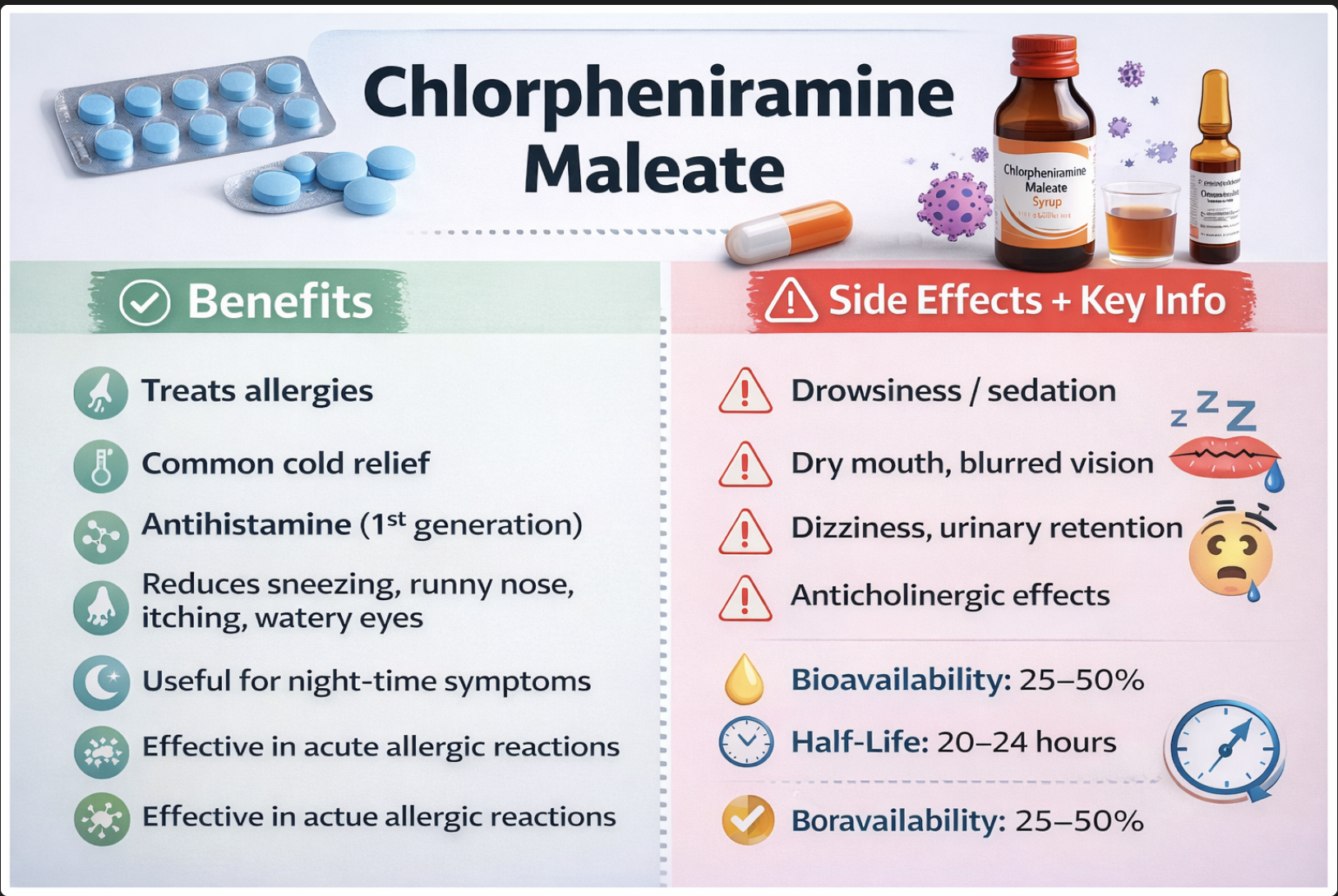
Chlorpheniramine Maleate is well absorbed after oral administration, with an oral bioavailability of around 25–50%. Food may slightly delay its absorption, but it does not significantly affect how well the medicine works. Many patients often ask questions like — should I take it before or after meals, and what should be the gap between doses? Let me clarify this here. This medicine can be taken with or without food, depending on your comfort, but taking it after meals may help reduce minor stomach discomfort. Since it is usually taken 2–3 times a day, it is important to maintain a proper gap between doses as advised by your doctor to ensure consistent effect and avoid unnecessary side effects.
key points:
- Chlorpheniramine Maleate is well absorbed after oral administration
- Oral bioavailability: ~25–50%
- Food may slightly delay absorption but does not significantly affect efficacy
Half-Life
Due to long half-life, sedative effects may persist, especially in elderly patients
Elimination half-life: 20–24 hours
It means it shows it effect in your body for up to 20-24 hours
Available Strengths & Dosage Forms
When you visit a pharmacy, chlorpheniramine is commonly available in different dosage forms for routine use. In most cases, patients will come across tablets and syrups, which are used for everyday allergy management. However, in hospital settings — especially during emergency situations or severe allergic reactions — it is also available in injectable form for faster and more controlled action.
- Tablet: 2 mg, 4 mg
- Syrup: 2 mg / 5 ml
- Injection: 10 mg / ml (IM / IV – hospital use)
Purpose / Indications
Chlorpheniramine Maleate is used to treat allergic conditions by blocking the effects of histamine in the body.
Symptoms Chlorpheniramine May Cure
Since Chlorpheniramine is a first-generation antihistamine, it works by blocking the effects of histamine in the body. Histamine is the main chemical responsible for most allergic symptoms, so when its action is blocked, these symptoms start improving. This includes common allergy-related problems such as:
- Sneezing
- Runny nose
- Itching (skin, eyes, nose)
- Watery eyes
- Urticaria (hives)
- Allergic skin rashes
- Common cold–related allergy symptoms
- Insect bite reactions
- Drug-induced allergic reactions
Dosage
Adults
- 4 mg, 2–3 times daily
Children
- 2–5 years: 1 mg, 2–3 times daily
- 6–12 years: 2 mg, 2–3 times daily
⚠️ Dose should always be adjusted as per physician advice.
Mechanism of Action
Chlorpheniramine Maleate works by competitively blocking H1 histamine receptors in the body.
This prevents histamine-mediated allergic responses such as itching, redness, swelling, and increased mucus secretion, It crosses the blood–brain barrier and causes sedation.
Detailed Explanation
Chlorpheniramine Maleate is a first-generation antihistamine that blocks histamine-mediated allergic responses.
Step-by-step explanation:
- During an allergic reaction, histamine is released from mast cells.
- Histamine binds to H1 receptors, causing:
- Vasodilation
- Increased capillary permeability
- Itching, redness, sneezing, and swelling
- It blocks H1 receptors, preventing histamine from exerting its effects.
As a result:
- Itching and redness decrease
- Sneezing and runny nose are controlled
- Allergic swelling is reduced
Additional pharmacological points:
- It crosses the blood–brain barrier, leading to sedation.
- It also has anticholinergic properties, which contribute to side effects like dry mouth.
- Sedative effect makes it useful in night-time allergy symptoms.
Summary statement:
Chlorpheniramine Maleate blocks H1 histamine receptors, reducing allergic symptoms such as itching, sneezing, redness, and swelling, but commonly causes sedation due to central nervous system penetration.
Side Effects
Common Side Effects
- Drowsiness / sedation
- Dry mouth
- Dizziness
- Blurred vision
Less Common / Rare
- Urinary retention
- Constipation
- Confusion (especially in elderly)
Contraindications
- Known hypersensitivity to chlorpheniramine
- Narrow-angle glaucoma
- Prostatic hypertrophy
- Severe liver disease (use with caution)
Dosage Frequency
- Usually taken 2–3 times daily
- Preferably at night due to sedative effect
In patients where pain or inflammation is a dominant symptom, antihistamines like cetirizine may be used along with other drug classes such as analgesics or NSAIDs, depending on the clinical condition.
Use in Special Populations
Pregnancy
I have often seen many pregnant women feeling concerned about whether this medicine is safe for them during this period or not. That’s exactly why I decided to include this section — to give you clear and practical guidance. When it comes to pregnancy, chlorpheniramine is generally considered safe when prescribed by a doctor, but it should only be used if clearly needed and when the benefits outweigh the potential risks. During lactation, it may pass into breast milk and can cause sedation in the infant, so it should be used with caution. In elderly patients, there is a higher risk of side effects like sedation and confusion, which is why lower doses are usually recommended.
- More Information here: https://www.ncbi.nlm.nih.gov/books/NBK582633/
Drug Interactions
- Alcohol (may increase drowsiness)
- CNS depressants (sedatives, sleeping pills)
I have personally seen patients in emergency settings who had taken chlorpheniramine and then consumed excessive alcohol without understanding the risks. This combination can be dangerous because both alcohol and chlorpheniramine depress the central nervous system. As a result, patients may experience extreme drowsiness, confusion, reduced alertness, and in severe cases, respiratory depression or even bradycardia (slow heart rate). That’s why alcohol and other CNS depressants, such as sedatives or sleeping pills, should be strictly avoided while taking this medication.
Storage Instructions
- Store at room temperature
- Keep away from moisture and direct sunlight
- Keep out of reach of children
Disclaimer
This information is for educational purposes only and should not be used as a substitute for professional medical advice. Always consult a doctor or pharmacist before using any medication.
Additional
Comparison: Chlorpheniramine Maleate vs Levocetirizine
| Parameter | Chlorpheniramine Maleate (CPM) | Levocetirizine |
|---|---|---|
| Generation | First-generation antihistamine | Second-generation antihistamine |
| Sedation | High (crosses BBB) | Minimal |
| Dosing frequency | 2–3 times daily | Once daily |
| Bioavailability | ~25–50% | ~85–90% |
| Half-life | 20–24 hours | ~8–10 hours |
| CNS penetration | Significant | Minimal |
| Anticholinergic effects | Present | Negligible |
| Use in daytime | Not preferred | Preferred |
| Use in night allergy | Useful | Optional |
| Preferred for chronic allergy | NO | YES |


3 thoughts on “Chlorpheniramine Maleate (CPM) : Uses, Dosage, Side Effects, Contraindications & Safety”