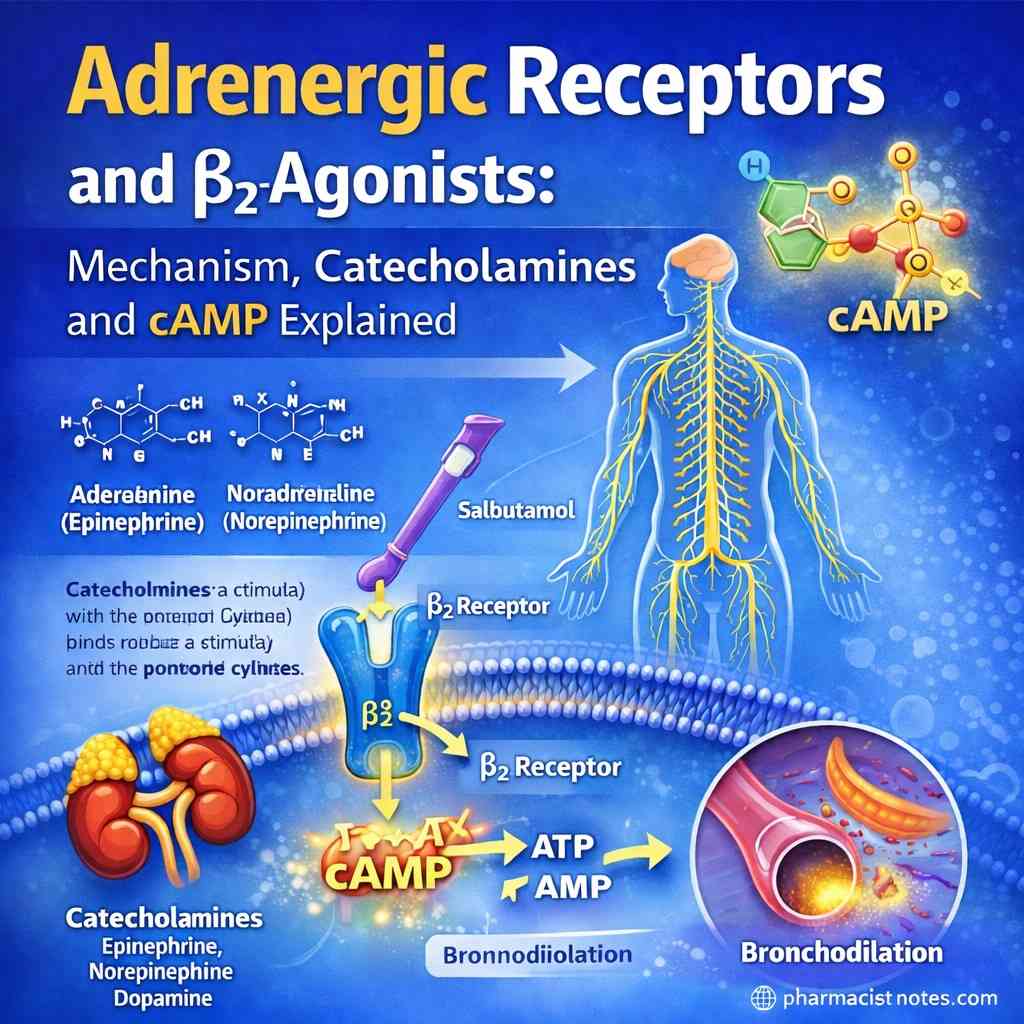
Adrenergic Receptors and beta2 Agonists
What are Adrenergic Receptors?
Adrenergic receptors are the receptors which respond to adrenaline (epinephrine) and noradrenaline (norepinephrine)
These receptors are part of sympathetic nervous system.
Location:
- Heart
- Lungs
- Blood vessels
- Liver
- Skeletal muscle
These are divided into Two categories :
| Type | Subtypes |
|---|---|
| Alpha | α1, α2 |
| Beta | β1, β2, β3 |

What are Catecholamines?
Catecholamines are natural chemicals released during the condition of stress as response for stress by our body
Main catecholamines:
- Epinephrine
- Norepinephrine
- Dopamine
These are released by adrenal medulla
Function:
- Heart rate increase
- BP increase
- Bronchodilation
- Fight or flight response

What are Beta-2 Receptors?
β₂ receptors are subtype of beta receptors (type of Adrenergic Receptors as explained above)
Mainly located in:
- Bronchial smooth muscle (lungs)
- Uterus
- Skeletal muscle
- Some blood vessels
Function:
When stimulated →
- Smooth muscle relaxation
- Bronchodilation (that’s why it is important to understand bronchodilators)
- Vasodilation
- Uterine relaxation
What are Agonist and Antagonist?
Agonist = A drug that activates a receptor to produce a biological response.
Example:
- Natural ligand:
Adrenaline activates the β₂ receptor. - Drug:
Salbutamol activates the β₂ receptor.
Therefore, salbutamol is a β₂-agonist.
Antagonist = A drug that blocks a receptor and prevents it from being activated.
Example:
- Propranolol is a beta blocker (β-antagonist) because it blocks β-adrenergic receptors.
What is cAMP ?
cAMP is Cyclic Adenosine Monophosphate.
This is second messenger molecule.
What Does “Second Messenger” Mean?
A second messenger is an intracellular signaling molecule that transmits the signal from a receptor to produce a response inside the cell.
In simple words:
- The first messenger is the hormone or drug (for example, adrenaline or salbutamol).
- The second messenger is the internal molecule inside the cell that carries the signal forward.
Example in β₂-Receptor Activation
- Salbutamol binds to the β₂ receptor (first messenger action).
- The receptor activates a G-protein.
- Adenylyl cyclase is stimulated.
- ATP is converted into cAMP.
- cAMP acts as a second messenger.
- This ultimately leads to smooth muscle relaxation (bronchodilation).
Why Is It Called “Second” Messenger?
It is called “second” because:
- The first messenger (drug or hormone) does not directly enter the cell.
- Instead, it binds to a receptor on the cell surface.
- The signal is then passed inside the cell through another molecule — the second messenger.

Quick Summary
| Term | Simple Meaning |
|---|---|
| Adrenergic receptor | Receptor responding to adrenaline |
| Catecholamines | Stress hormones (adrenaline, noradrenaline) |
| β₂ receptor | Lung smooth muscle relaxation receptor |
| Agonist | Activates receptor |
| Antagonist | Blocks receptor |
| cAMP | Second messenger that causes relaxation |
| Gs protein | Activates adenylyl cyclase |
Definitions in Shorts
What are adrenergic receptors?
Adrenergic receptors are receptors that respond to catecholamines such as adrenaline (epinephrine) and noradrenaline (norepinephrine). They are part of the sympathetic nervous system and regulate heart rate, blood pressure, and airway tone.
What are the main types of adrenergic receptors?
Adrenergic receptors are divided into two main types:
- Alpha receptors: α₁ and α₂
- Beta receptors: β₁, β₂, and β₃
Each subtype has different functions in the body.
What are catecholamines?
Catecholamines are natural stress hormones released by the adrenal medulla. The main catecholamines are:
- Epinephrine
- Norepinephrine
- Dopamine
They are responsible for the “fight or flight” response.
What is a β₂ receptor?
A β₂ receptor is a type of beta-adrenergic receptor mainly found in the lungs, blood vessels, and skeletal muscle. When activated, it causes smooth muscle relaxation and bronchodilation.
What is an agonist?
An agonist is a drug that binds to and activates a receptor to produce a biological response.
Example: Salbutamol is a β₂-agonist because it activates β₂ receptors.
What is an antagonist?
An antagonist is a drug that binds to a receptor but blocks its activation.
Example: Propranolol is a beta-blocker (β-antagonist).
What is cAMP?
cAMP (Cyclic Adenosine Monophosphate) is a second messenger molecule inside the cell that transmits signals from receptors to produce a physiological response.
Why is cAMP called a second messenger?
It is called a second messenger because:
- The first messenger (hormone or drug) binds to a receptor on the cell surface.
- The signal is then transmitted inside the cell through cAMP.
- cAMP carries the signal forward to produce the final effect.
How do β₂-agonists cause bronchodilation?
β₂-agonists bind to β₂ receptors → activate G-protein → stimulate adenylyl cyclase → increase cAMP → relax smooth muscle → cause bronchodilation.
Where are β₂ receptors mainly located?
They are mainly found in:
- Bronchial smooth muscle (lungs)
- Blood vessels
- Uterus
- Skeletal muscle


One thought on “Fundamentals of Adrenergic Pharmacology: Adrenergic Receptors and beta2 Agonists, Antagonist and cAMP Explained”