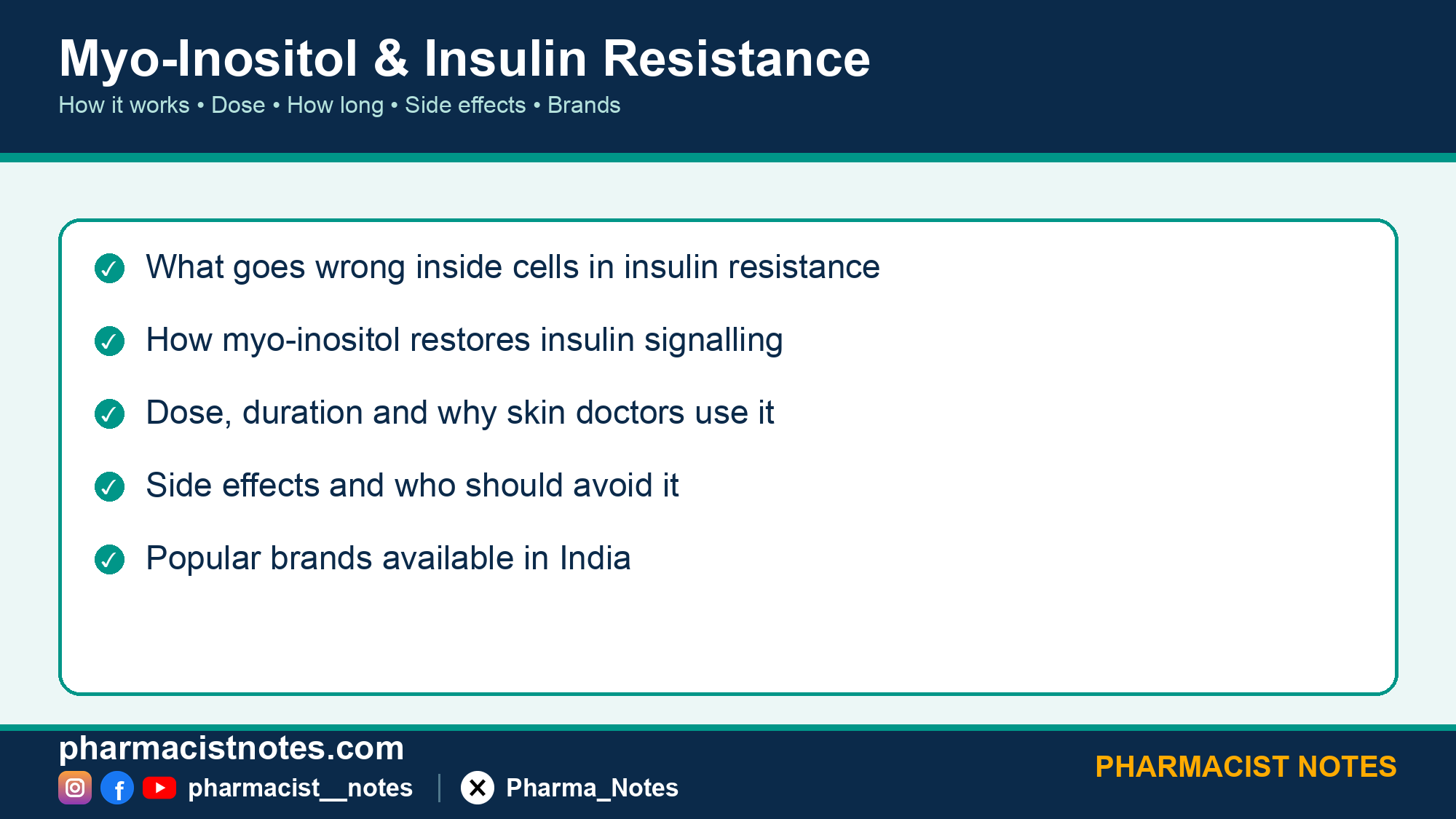
Myo inositol is a sugar-like molecule your body makes and also gets from food, and it plays a direct role in how your cells respond to insulin. It is widely prescribed by gynaecologists, endocrinologists and even dermatologists for women with PCOS and insulin resistance. This article is a continuation of our guide on insulin resistance symptoms, tests and medicines. Here we go deeper: what actually breaks inside the cell, how myo inositol steps in, the usual dose and duration, side effects, who should avoid it, and popular brands.
Medical Disclaimer: This article is for educational purposes only and is not a substitute for professional medical advice, diagnosis or treatment. Do not start, stop or change any medicine or supplement without consulting your doctor or pharmacist. Pharmacist Notes does not provide individual medical advice, and results can vary from person to person.
Disclosure: Some links in this article are Amazon affiliate links. If you buy through them, Pharmacist Notes may earn a small commission at no extra cost to you. As an Amazon Associate we earn from qualifying purchases. Product details are taken from the Amazon.in listings and this is not an instruction to buy without medical advice.

Table of Contents
What Is Myo Inositol?
Myo inositol (MI) is a naturally occurring carbocyclic sugar alcohol, sometimes loosely called vitamin B8, although it is not a true vitamin because the body makes it from glucose. Your cells hold large amounts of it, especially in the brain, ovaries, muscle and fat. Foods such as fruits, beans, grains and nuts provide small amounts, usually under 1 g a day.
Myo inositol is one of nine stereoisomers of inositol. The other one that matters here is D-chiro inositol (DCI), which the body makes from myo inositol using an enzyme. Supplements for insulin resistance and PCOS contain either myo inositol alone or a combination of both.
What Happens Inside Your Cells in Insulin Resistance
To understand why myo inositol helps, you first need to see how insulin normally works and where the chain breaks.
Step 1: How Insulin Normally Works
- Insulin binds to the insulin receptor on the cell surface. The receptor is a tyrosine kinase, so it switches itself on by adding phosphate groups to its own tyrosine residues.
- The activated receptor phosphorylates adaptor proteins called IRS-1 and IRS-2 (insulin receptor substrates).
- IRS proteins recruit and activate PI3 kinase (PI3K). PI3K converts the membrane lipid PIP2 into PIP3.
- PIP3 activates PDK1 and then Akt (protein kinase B), the main messenger of insulin.
- Akt moves storage vesicles carrying the glucose transporter GLUT4 to the cell surface. GLUT4 opens a gate that lets glucose in. Akt also activates glycogen storage and switches off glucose production in the liver.

Step 2: Where the Signal Breaks
In insulin resistance the insulin level is high, but the message gets blocked after the receptor. Several problems work together:
- Excess fat inside cells (lipotoxicity). When muscle and liver cells receive more free fatty acids than they can burn, fat by-products such as diacylglycerol (DAG) and ceramides build up. DAG activates protein kinase C enzymes, and ceramides directly restrain Akt.
- Wrong phosphorylation of IRS. Instead of tyrosine, IRS-1 gets phosphate groups on serine residues. This blocks its normal signalling. Studies in PCOS found increased serine phosphorylation of the insulin receptor in roughly half of the women tested.
- Chronic low-grade inflammation. Fat tissue releases TNF-alpha and IL-6, which activate JNK and IKK kinases that again promote serine phosphorylation of IRS-1.
- Oxidative and ER stress. Overloaded mitochondria produce reactive oxygen species, and a stressed endoplasmic reticulum sends signals that further dampen insulin action.
- Fewer and weaker GLUT4 transporters. Even when some signal arrives, fewer GLUT4 vesicles reach the surface, so glucose stays in the blood.
Step 3: Selective Resistance and the Rise in Insulin
Because glucose entry is blocked, the pancreas makes more insulin to compensate. Not all tissues become resistant equally. The PI3K-Akt (metabolic) branch is blunted in muscle, fat and liver, but the MAPK (growth) branch often remains sensitive. In the ovary, high insulin therefore keeps stimulating theca cells to make androgens. This explains the acne, excess hair and irregular cycles of PCOS even when blood sugar looks normal.
If you are new to the topic, start with our guide on insulin resistance symptoms and tests, then return here.
How Myo Inositol Works
Inositols are part of the same signalling machinery that insulin uses. Researchers suggest that a shortage or poor handling of inositol messengers may add to the problem. The main mechanisms proposed are:

1. Raw Material for PIP2, PIP3 and IP3
Myo inositol is built into membrane lipids called phosphatidylinositols. These become PIP2 and then PIP3, the very lipid that insulin needs for PI3K-Akt signalling. When PIP2 is split by phospholipase C it also produces IP3, a second messenger that releases calcium inside cells. Calcium signalling carries messages for insulin and for FSH in the ovary.
2. Inositol Phosphoglycan (IPG) Messengers
When insulin binds its receptor, it also triggers the release of small inositol-containing messengers called inositol phosphoglycans. One type contains myo inositol and the other contains D-chiro inositol. These IPGs activate enzymes that burn glucose (pyruvate dehydrogenase) and store it (glycogen synthase). Lower levels of DCI-containing IPGs have been reported in people with insulin resistance and PCOS.
3. The Epimerase Enzyme and the 40:1 Ratio
An insulin-dependent enzyme called epimerase converts myo inositol into D-chiro inositol. In healthy blood, the ratio of MI to DCI is about 40 to 1, which is why many supplements use the same ratio. In insulin-resistant muscle, fat and liver, epimerase works poorly, so DCI falls. Reports also suggest that these patients lose more inositol in urine.
4. The Ovarian DCI Paradox
The ovary behaves differently. It stays insulin sensitive, so with high insulin the ovary over-converts MI to DCI. Myo inositol falls, FSH signalling weakens and egg quality can suffer, while extra DCI pushes androgen production up. This is called the DCI paradox. It is one reason high doses of DCI alone may not be ideal, and why myo inositol or a 40:1 combination is preferred in PCOS.
Important: these mechanisms are well supported in laboratory and small human studies, but they remain a working explanation. Not every step has been proven in large clinical trials.
What the Evidence Says
Many trials report that inositol improves cycle regularity, insulin markers and sometimes ovulation. The quality of that evidence is mixed. The 2023 international evidence-based PCOS guideline treats inositol as an experimental therapy with a possible effect on irregular cycles and insulin resistance, supported by a conditional recommendation until better trials are available. A systematic review of about 30 trials involving roughly 2,200 women concluded that evidence for inositol in PCOS was limited and inconclusive, with some metabolic benefit and possible ovulation benefit, but no effect on other outcomes.
The same review found that myo inositol probably causes fewer stomach side effects than metformin, and these were usually mild. You can browse the research yourself with this PubMed search on myo inositol and PCOS.
| Feature | Myo inositol | Metformin |
|---|---|---|
| Type | Dietary supplement | Prescription medicine |
| Main action | Improves insulin signalling messengers | Lowers liver glucose output, improves insulin sensitivity |
| Typical GI upset | Mild | More frequent |
| Evidence strength | Limited, mixed | Stronger for diabetes prevention |
| Best role | Add-on or alternative in PCOS, decided by doctor | First-line for prediabetes and diabetes |
Myo Inositol Dose and How Long Doctors Prescribe It

- Common dose: around 2 g twice daily (4 g a day), usually taken with 200 to 400 mcg of folic acid.
- 40:1 combination: about 2,000 mg myo inositol with 50 mg D-chiro inositol a day.
- First course: usually 3 to 6 months. After that your doctor checks periods, skin, weight, fasting glucose, HbA1c and insulin before deciding on continuing.
- When trying for pregnancy: sometimes continued under a doctor’s guidance until pregnancy is confirmed. Once you are pregnant, continue only if your doctor specifically advises it.
- Long term: some women continue for 12 months or more. Data beyond that are limited, so need should be reassessed regularly.
Take it with or after food if it upsets your stomach. Powder sachets are dissolved in water, while capsules and tablets are taken in divided doses. Do not exceed the label dose without medical advice. Lifestyle remains the foundation, as explained in our guide on how to reverse insulin resistance.
Why Skin Doctors Prescribe Myo Inositol for Women
Many skin problems in women are driven by hormones. High insulin raises androgens, and androgens make oil glands overactive and hair follicles sensitive. When dermatologists see a woman with persistent adult acne, excess facial hair, scalp hair thinning or dark velvety neck patches, they often suspect PCOS or insulin resistance and may add myo inositol alongside standard treatment.

- Hormonal acne: lower insulin may reduce androgen drive and oil production.
- Hirsutism (excess facial and body hair): reduced androgen levels may slow new growth.
- Female pattern hair thinning: used as support in PCOS-related hair loss.
- Acanthosis nigricans: the dark patches fade when insulin levels fall.
It is usually an add-on, not a stand-alone treatment. Evidence for skin outcomes is smaller than for cycles and metabolic markers, and improvement takes months. Acne treatments, anti-androgens and hair treatments are still prescribed when needed.
Myo Inositol Side Effects
At about 4 g a day, myo inositol is generally well tolerated. Reported effects include:
- Nausea, gas, bloating, stomach discomfort or loose stools, usually mild and temporary.
- Headache or dizziness.
- Sleep disturbance or fatigue at higher doses.
- At around 12 g a day or more (studied in psychiatric trials), side effects increase.
- Possible lowering of blood sugar in people taking insulin or sulfonylureas.
Starting at half the dose for a week and then increasing, or taking it with food, often reduces stomach upset. Report any rash, swelling or severe symptoms to your doctor.
When Myo Inositol Should Not Be Prescribed

There is no universal list of absolute contraindications, because it is a supplement with limited data. Doctors usually avoid it or use extra caution in these situations:
- Allergy or intolerance to inositol or any ingredient in the product.
- Pregnancy and breastfeeding, unless your doctor specifically advises it.
- Bipolar disorder or lithium treatment, since inositol is involved in the pathway lithium acts on and may interact.
- Kidney disease, because safety data are lacking.
- Diabetes on insulin or sulfonylureas, because blood sugar can fall further and doses may need adjusting.
- Combination products with extra minerals or herbs that are not suited to you, for example when you already take zinc, selenium or NAC from another source.
- Self-diagnosis: irregular periods can come from thyroid disease, high prolactin or pregnancy, so get tested before starting.
- Children and men, unless a specialist recommends it.
Popular Myo Inositol Brands in India
Several brands sell myo inositol in India. The details below come from the Amazon.in listings at the time of writing. Check the label for exact amounts, and talk to your doctor or pharmacist before choosing.

| Product | Form | Key contents (per listing) | Notes |
|---|---|---|---|
| Akya PCOS Hormonal Balance 40:1 capsules (Amazon.in) | 120 capsules | Myo and D-chiro inositol 40:1 (2,050 mg blend), chromium, folate, black pepper extract; 4 capsules a day | Single-purpose inositol product with folate; listing rated 4.6/5 from a small number of ratings |
| PCOS Complete by Plus Plus (Amazon.in) | Powder sachets (lemon) | Myo inositol 2,000 mg, D-chiro inositol 50 mg (40:1), NAC 600 mg, CoQ10 75 mg, plus zinc, selenium, folate, vitamin D3 and L-carnitine; 1 sachet a day | Multi-ingredient formula; listing rated about 4/5, with some buyers finding the taste sour |
| Carbamide Forte | 60 tablets | Myo inositol and D-chiro inositol in a 40:1 ratio | Widely reviewed on Amazon.in; no link provided |
| Trexgen Ovahope | Tablets | Myo inositol 1,000 mg with D-chiro inositol | Listed on Amazon.in; no link provided |
How to choose. Check how many milligrams of myo inositol you get per day, whether the 40:1 ratio is stated, whether folic acid is included, and who manufactures it. Multi-ingredient products can be convenient, but extras such as NAC, zinc and selenium are not needed by everyone. One reviewer of a multi-ingredient product reported hair fall and said their doctor advised against extra minerals; that is a single anecdote, not proof, but it shows why a doctor should review any combination formula.
Prices change often, so check the current price on the product pages: Akya PCOS Hormonal Balance 40:1 capsules (Amazon.in) and PCOS Complete by Plus Plus (Amazon.in).
Myo Inositol FAQ
What is myo inositol used for?
Myo inositol is used as a supplement to improve insulin sensitivity and support ovulation and cycle regularity, mainly in women with PCOS. It is also studied for gestational diabetes prevention, metabolic syndrome and hormonal skin problems.
How long does myo inositol take to work?
Most doctors review progress after 3 months. Cycle regularity, skin changes and blood sugar markers usually take 8 to 12 weeks or longer to change, so early results should not be expected.
Can I take myo inositol with metformin?
Many doctors combine them, and the combination is generally considered safe, but the decision and the doses should come from your doctor. Monitor blood sugar if you have diabetes.
Is myo inositol safe for long-term use?
It is well tolerated at about 4 g a day in trials lasting months, but long-term safety data beyond 6 to 12 months are limited. Ask your doctor to review the need regularly.
What is the best ratio of myo inositol to D-chiro inositol?
A 40:1 ratio of myo inositol to D-chiro inositol is the most commonly used, because it mirrors the ratio found in blood. Evidence that it beats myo inositol alone is still being studied.
Does myo inositol cause weight gain or weight loss?
It does not directly cause weight gain. Some women lose a little weight as insulin sensitivity improves, but it is not a weight-loss drug and works best with diet and exercise.
Can men take myo inositol?
Men are not the usual target, and most products are marketed to women with PCOS. Inositol has been studied for sperm quality and metabolic syndrome, but a doctor should guide use.
Can myo inositol replace insulin resistance medicines?
No. It is a supplement with limited, mixed evidence. If you have prediabetes or diabetes, it does not replace metformin or other prescribed medicines unless your doctor says so.
Conclusion
Insulin resistance starts when the insulin signal is blocked inside the cell by fat by-products, inflammation and wrong phosphorylation of IRS. Myo inositol supplies the building blocks for the messengers insulin uses and may help restore the balance with D-chiro inositol, which is why doctors prescribe it, mostly for women with PCOS. The evidence is promising but limited, so treat it as a helper alongside diet, exercise and medical care, not a magic fix. Review your need with your doctor every few months, and read our full guide on insulin resistance to cover the basics.
Disclaimer: This article is for education only and is not medical advice. Consult your doctor or pharmacist before starting, stopping or combining any supplement or medicine.
Follow Pharmacist Notes: pharmacistnotes.com | Instagram, Facebook, YouTube: pharmacist__notes | X: Pharma_Notes
References
- Teede HJ et al. Recommendations from the 2023 international evidence-based guideline for the assessment and management of polycystic ovary syndrome (ESHRE-endorsed). Fertil Steril / Eur J Endocrinol / Hum Reprod. 2023.
- Unfer V et al. Myo-inositol effects in women with PCOS: a meta-analysis of randomized controlled trials. Endocr Connect. 2017;6(8):647-658.
- Official labelling and national supplement regulator guidance for inositol products; evidence for specific doses and thresholds in this article is limited and should be confirmed with your doctor.


One thought on “Myo Inositol for Insulin Resistance: How It Works, Dose, Side Effects & Brands”